Last week you did three sets of ten. This week, same weight, same sets, same reps, and your body looks exactly the same. Not having a full rack of dumbbells is not what's holding you back. Progressive overload has five distinct paths, and four of them require zero added weight. All of them can be tracked and executed at home, starting today.
Quick-Reference: 5 Progressive Overload Variables
|
Variable |
What You Change |
Needs More Weight? |
|
Load |
Increase resistance |
Yes |
|
Reps |
Do more reps per set |
No |
|
Sets |
Add a set |
No |
|
Tempo |
Slow down the movement |
No |
|
Rest |
Reduce rest between sets |
No |
Yes, You Can Progressive Overload at Home
Progressive overload means giving your body a challenge that's slightly harder than what it already adapted to. The common assumption is that this requires heavier weights every session, but load is only one of five variables you can adjust.
For home trainers, the four non-load variables are often more accessible and easier to track precisely:
- Reps: do more repetitions with the same weight
- Sets: add one working set to your session
- Tempo: extend the lowering phase to increase time under tension
- Rest reduction: complete the same work in less total time
Any one of these, applied consistently over weeks, creates the stimulus your muscles need to grow and strengthen. Sports science research confirms that increased repetitions, manipulated rest periods, and technique improvements produce comparable muscle growth results to simply adding weight. You do not need heavier resistance every week to make real progress.
Why Home Gym Progress Stalls
Most home training plateaus come down to three specific problems.
- Dumbbell jumps are too large. A standard dumbbell set often jumps from 20 lbs to 25 lbs, a 25% increase. For smaller muscle groups like the shoulders, going from 10 lbs to 15 lbs is a 50% jump. That gap is too wide for most movements. The next weight is too hard to complete cleanly, so you repeat the same weight indefinitely with no new stimulus reaching the muscle.
- There's no training log. Without a written record, you have no way to confirm progress happened. You might feel like you trained harder, but feeling is not data. If you can't look back and verify that you did more than last week, there's a good chance you didn't.
- Exercise variation is too frequent. Switching exercises too often resets the adaptation process every time. Consistency on a small set of movements, tracked carefully over weeks, is what produces measurable strength gains at home. Novelty feels productive but rarely is.
These three problems share a root cause: equipment limitations and recording habits, not lack of effort.

4 Ways to Keep Making Progress Without Adding Weight
1. Double Progression
Pick a rep range, such as 3 sets of 8 to 12. Start at 3×8. Add one rep per session until you hit 3×12 across all sets, then increase load. This gives every session a clear target and keeps you within a defined window without needing new equipment.
Example: Week 1: 3×8 at 20 lbs. Week 3: 3×10 at 20 lbs. Week 5: 3×12 at 20 lbs. Week 6: move to 22.5 lbs, reset to 3×8.
2. Density Training
Keep the total reps and weight the same, but shorten your rest periods or fit more total reps into a fixed time block. Completing 85 reps in 20 minutes instead of 80 reps is a real, measurable improvement that requires no extra equipment at all.
Example: Set a 15-minute timer for a movement. Record total reps. Add two to three reps the following week within the same window.
3. Tempo Manipulation
Slow the lowering phase of any movement from 1 second to 3 or 4 seconds. The muscle stays under tension longer, which is one of the primary drivers of muscle growth. The resistance in your hands does not change; the movement becomes more challenging due to increased time under tension.
Example: A standard squat with a 1-second lower becomes far more demanding with a 4-second lower. Same weight, meaningfully higher stimulus.
4. Rest Reduction
Cut rest periods by 15 seconds every one to two weeks. Performing the same sets and reps with shorter recovery is objectively harder and forces real cardiovascular and muscular adaptation.
Example: Week 1: 90 seconds rest. Week 3: 75 seconds rest. Week 5: 60 seconds rest.
Why Your Equipment Choice Sets the Ceiling on Your Progress
The four methods above can carry you a long way, but at some point, you need to add resistance. This is where home gym equipment creates a structural limit that effort alone cannot solve.
Fixed dumbbell increments create an unavoidable bottleneck. If you're stuck between 20 lbs and 25 lbs, there is no clean progression path. You either repeat the same workout or attempt a jump that breaks your form. Neither option moves you forward.
Cable-based systems address this in three meaningful ways.
Micro-Loading Precision
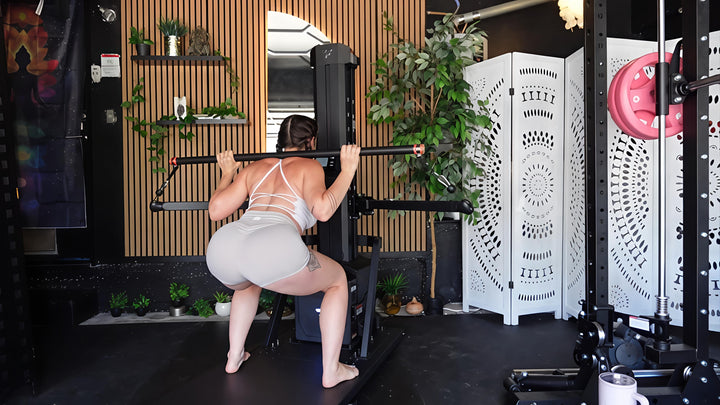
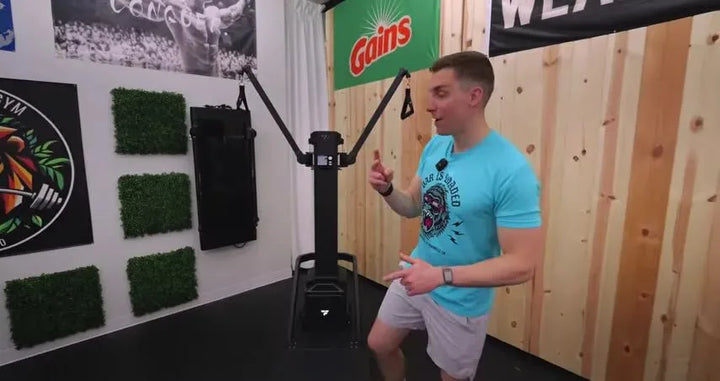
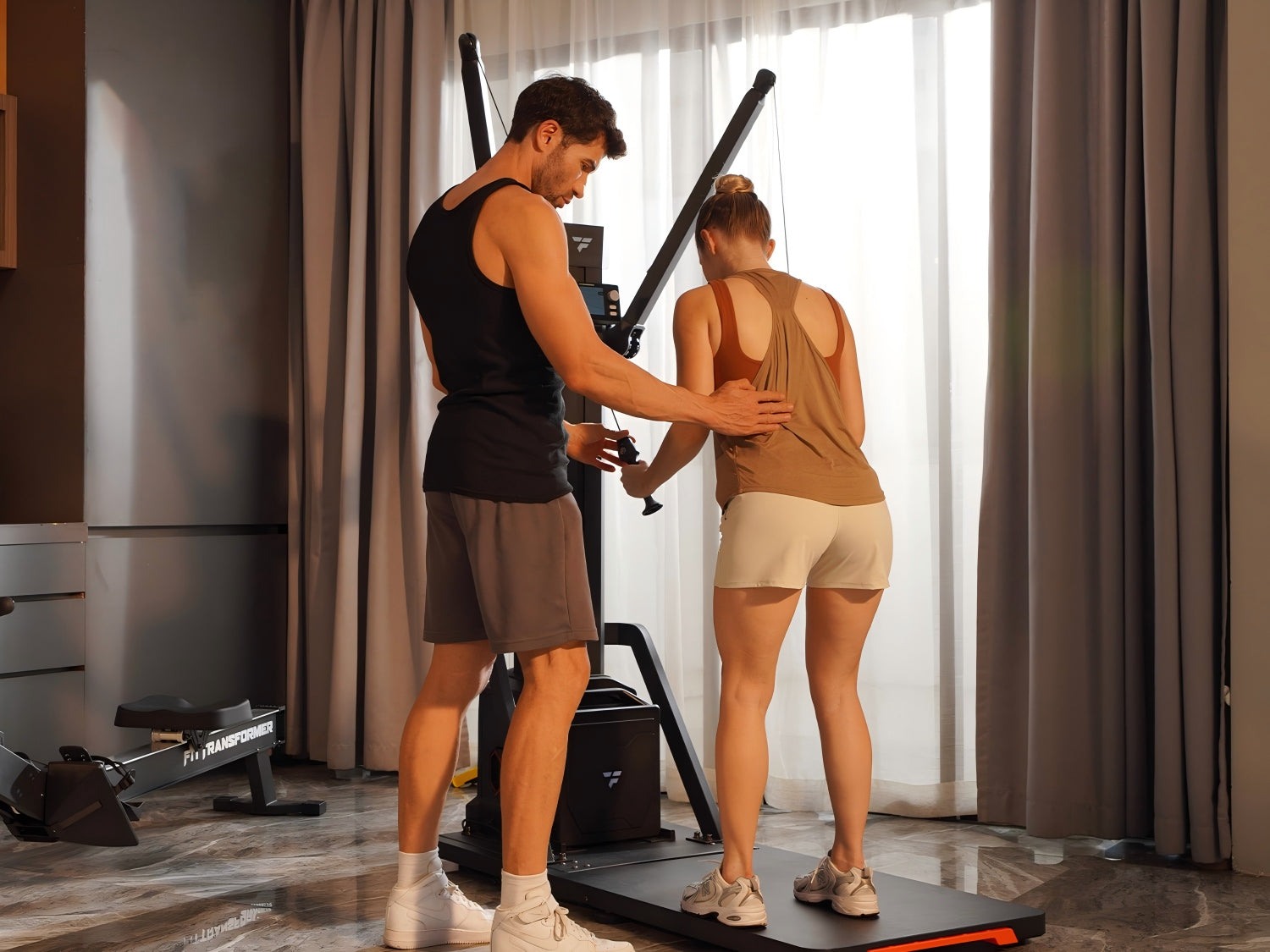
Advanced motor-driven cable units, like FitTransformer, can adjust resistance by a single pound. That means you can progress weekly instead of waiting until you're ready for a 5-pound jump. For intermediate and advanced trainees especially, this precision is the difference between consistent progress and a prolonged plateau.
Constant Tension Through the Full Range
With a dumbbell lateral raise, tension drops to near zero at the bottom of the movement. A cable keeps the target muscle loaded from the start of the stretch to the peak contraction, making each repetition more effective than its dumbbell equivalent.
Angle Adjustability Without New Equipment
Shifting the pulley height by a few inches changes the line of pull and targets the muscle from a fresh angle. A plateau at one position becomes a starting point at another, all on the same machine.
FitTransformer is built around this approach. It's a home cable system that supports 1-pound weight increments and covers a wide resistance range from beginner to advanced training loads. If fixed dumbbell jumps have been the ceiling on your progress, a system with this level of precision helps you break through that ceiling.

How to Track Progress So You Never Repeat the Same Workout Twice
A training log does not need to be complicated. Four fields per session are enough:
|
Field |
What to Record |
|
Exercise |
Name of the movement |
|
Weight |
Resistance used |
|
Sets × Reps |
What you actually completed |
|
Rest |
Time between sets |
Sample Weekly Log:
|
Date |
Exercise |
Weight |
Sets × Reps |
Rest |
|
Mon |
Cable Row |
40 lbs |
3×10 |
75 sec |
|
Wed |
Cable Row |
40 lbs |
3×11 |
75 sec |
|
Fri |
Cable Row |
40 lbs |
3×12 |
75 sec |
When Friday shows 3×12, next Monday you increase weight by 1 to 2 lbs and reset to 3×8 or 3×10. That is a complete, repeatable progression cycle with no guesswork involved.
The log is not optional. Without it, every session is a guess and your body has no reason to change.
Start Your First Measurable Week
Progress stops when the method stops, not when the equipment runs out. If you've been training without a log, start one today. Even a notes app works. If you've been stuck because your dumbbells jump too far, FitTransformer's cable system lets you move in 1-pound steps so progress stays consistent week to week. Pick one variable from this article, track it, and give it four weeks. That's the complete system.

FAQ
Q1: How do you know when it's time to increase weight at home?
When you complete all your target reps across every set, for example 3×12 when your range is 8 to 12, that's the signal to add weight. Increase by the smallest amount available and keep form clean throughout. If form breaks down on the first set, the new weight isn't ready yet.
Q2: Can bodyweight exercises really build muscle long-term?
Yes, with one condition: difficulty has to keep increasing. That means progressing to harder variations, from a standard push-up to a close-grip push-up to an archer push-up, rather than simply adding reps until fatigue. Higher-difficulty variations create the mechanical tension that drives muscle growth. Repetition volume alone, without increasing difficulty, produces diminishing returns fairly quickly.
Q3: How often should beginners update their training log?
Log every session immediately after training, not from memory the next day. Beginners need only three fields to start: exercise name, weight used, and sets completed times reps completed. That's enough information to confirm week-over-week direction and catch stalls early.
Q4: Is soreness a sign that progressive overload is working?
Not directly. Soreness signals a new stimulus and shows that something changed in the session. It is not a reliable marker of progress on its own. The actual indicators are completing more reps with the same weight, finishing the same workout in less time, or handling more total volume in a session. Those numbers confirm progress has happened. Soreness only confirms that something was different.