This debate has run in gyms for decades, and both sides have passionate defenders. But the science gives a calmer answer than you might expect. A more useful one, too. Both cable machines and free weights build muscle effectively. The real question is understanding what each tool does well, and how to use them together based on your goals and your setup.
Quick Answer at a Glance
Both tools work. For small home gyms, a smart cable system can cover more use cases than standalone cables or dumbbells.
|
Factor |
Free Weights |
Cable Machine |
Smart Digital Cable (Titan) |
|
Muscle growth |
Equal |
Equal |
Equal |
|
Strength specificity |
Best on free weight tests |
Best on cable tests |
Best on cable-style tests |
|
Stabilizer activation |
High |
Lower |
Lower |
|
Tension through full range |
Partial |
Full |
Full and constant |
|
Systemic fatigue per session |
Higher |
Lower |
Lower |
|
Solo safety at failure |
Needs a spotter |
Safe |
Safe, with automatic weight adjustment |
|
Footprint |
Medium to large |
Large |
Folds to about 30 in deep |
|
Max resistance |
Limited by plates owned |
Stack limit |
264 lbs digital |
|
Subscription required |
None |
None |
None |
The Science Answer First: Which Builds More Muscle?

Both can build similar amounts of muscle when training volume is equal.
A 2023 systematic review in BMC Sports Science, Medicine and Rehabilitation analyzed 13 studies with over 1,000 participants. The finding: no measurable difference in muscle growth between free weight and machine-based training.
What actually drives muscle building stays consistent across both tools:
- Progressive overload
- Sufficient training volume
- Adequate recovery
Current evidence confirms that muscular adaptations can be achieved across a wide spectrum of loading zones when effort is sufficient, according to loading recommendations for hypertrophy.
There is one important distinction, though: strength gains are tool-specific.
This is called the "specificity of strength" principle. People who train with free weights improve more on free weight tests. Those who train on cables or machines improve more on those same tests.
Neither result means one method is superior. It means your body adapts precisely to the demands you place on it.
Keep this in mind when choosing a training approach, especially if you have a specific performance goal.
What Free Weights Do That Cables Can't Replicate
The biggest advantage of free weights is multi-joint movement and functional strength transfer.
Recruit More Muscles Per Rep
When you pick up a dumbbell or barbell, your body moves in three-dimensional space with no fixed track guiding the weight. To control it, your nervous system activates a wide range of supporting muscles:
- Core stabilizers
- Smaller rotator muscles
- Joint-supporting structures
All of these work alongside the primary movers in every rep. Over time, this builds coordination and strength that transfers well to everyday physical demands.
Cover More Ground in Less Time
Squats, deadlifts, and bench press recruit multiple muscle groups and joints at once, delivering broad stimulus in a single movement. Few cable exercises match that coverage per set.
Transfer Better to Athletic Performance
Research on jump performance is mixed, but free weights train coordination under load in ways that mirror sport movements. For athletes focused on speed and power, free weights remain the practical choice.
Beginners Build Better Patterns
For newer lifters, free weights develop movement patterns and body awareness that carry into almost every other form of training.
What Cables Do That Free Weights Can't
Cable machines have one mechanical advantage that free weights physically cannot match: constant tension across the full range of motion.
Keep Your Muscle Loaded Through the Entire Rep
Here is why this matters with a simple comparison:
|
Position in a dumbbell curl |
Effective tension on the bicep |
|
Bottom of the movement |
Near zero |
|
Middle of the arc |
High |
|
Top of the movement |
Low |
The force angle between your forearm and the dumbbell becomes nearly parallel at the top and bottom, so the muscle works far less at those points. A cable pulley changes this by redirecting the line of resistance so your muscle stays loaded throughout the entire range.
A 2025 cable vs. dumbbell lateral raise study tested this directly. Cable lateral raises vs. dumbbell lateral raises over eight weeks produced no notable difference in deltoid growth.
The takeaway: the two resistance profiles were fully interchangeable for growth. You can pick cables wherever they fit your setup better without sacrificing results.
How Smart Digital Resistance Changes Cable Training
Traditional cable stacks improve on free weights, but the plates still carry inertia. They accelerate, drift, and briefly unload the muscle at each turnaround. Smart digital resistance removes that. Motor-controlled tension stays truly constant from the first inch to the last, with a zero-inertia feel that makes cheating with momentum nearly impossible.
Digital control also improves the lowering phase. Resistance stays engaged as the muscle lengthens, the part of the rep where much of the growth stimulus comes from. Constant tension through both phases extends time under tension in every set without adding joint stress.
Change the Pulley Height Shifts Which Muscles Work
Changing the pulley height changes which part of a muscle gets emphasized:
|
Pulley position |
Cable fly target |
|
High pulley |
Lower chest |
|
Mid pulley |
Mid chest |
|
Low pulley |
Upper chest |
Achieving the same variety with free weights typically requires switching to completely different exercises.
Tire You Out Less While Doing Similar Work

This concept is called the stimulus-to-fatigue ratio. Compare two chest exercises:
- Cable chest fly: targets the pectoral muscles with minimal demand on the triceps, shoulders, or spinal stabilizers
- Barbell bench press: heavy compound movement that taxes multiple muscle groups at once
Neither is better. They serve different roles. For high-frequency training, recovery phases, or addressing specific weak points, the lower systemic cost of cable isolation work is a real practical advantage.
What "Combining Both" Actually Looks Like in Practice
The most effective approach is not a choice between cables and free weights. The goal is using each where it performs best. According to free-weight vs. machine-based strength training research, combining free weights and machines may lead to more complete muscle development.
Different tools create different mechanical stimuli, and exposing a muscle to varied angles and tension profiles tends to produce more complete development.
|
Training phase |
Tool |
Why |
|
Start of session (high energy) |
Free weights |
Heavy compound movements: squats, deadlifts, press |
|
Mid to late session |
Cables |
Isolation work with full-range tension and precise angles |
The main barrier to this approach is access. At a commercial gym, cable machines are frequently occupied. At home, running two full systems requires substantial space and investment. That's what we'll address next.
Should You Use Cables or Free Weights at Home?
If space and budget are limited, a system that delivers cable training capability alongside multiple training modes covers the most ground per square foot.
Two Systems Take Up More Space Than Most Homes Have
- A full dumbbell rack plus a dedicated cable machine can exceed 100 square feet of floor space
- The two setups don't share components or overlap in function
- Each requires its own budget, its own footprint, its own maintenance
For practical guidance on measuring and planning your available training area, this home gym space planning guide covers active workout clearance in detail.
Cables Let You Train Hard Without a Spotter
Without a spotter, training to muscular failure with heavy free weights carries real risk. On a cable machine, reaching failure simply means the stack drops. Pushing close to failure is one of the most effective ways to drive muscle growth, and cables make that possible when training alone.
A Modular Gym System Covers Both in One Footprint
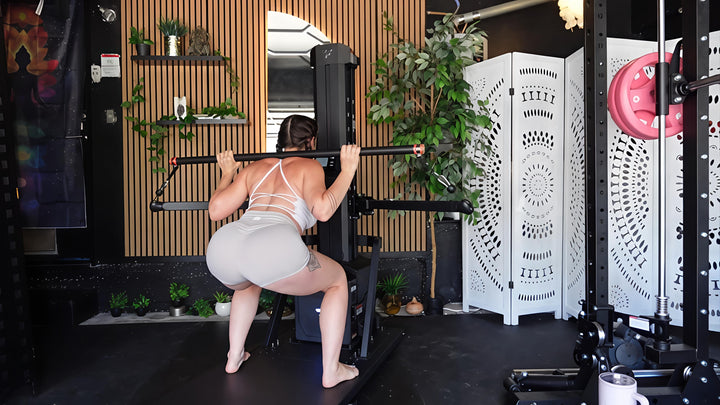
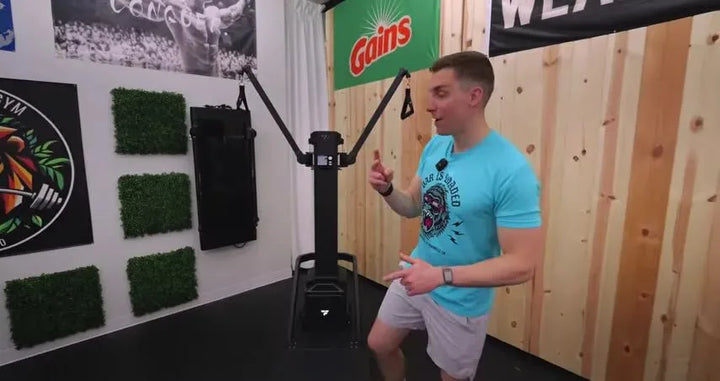
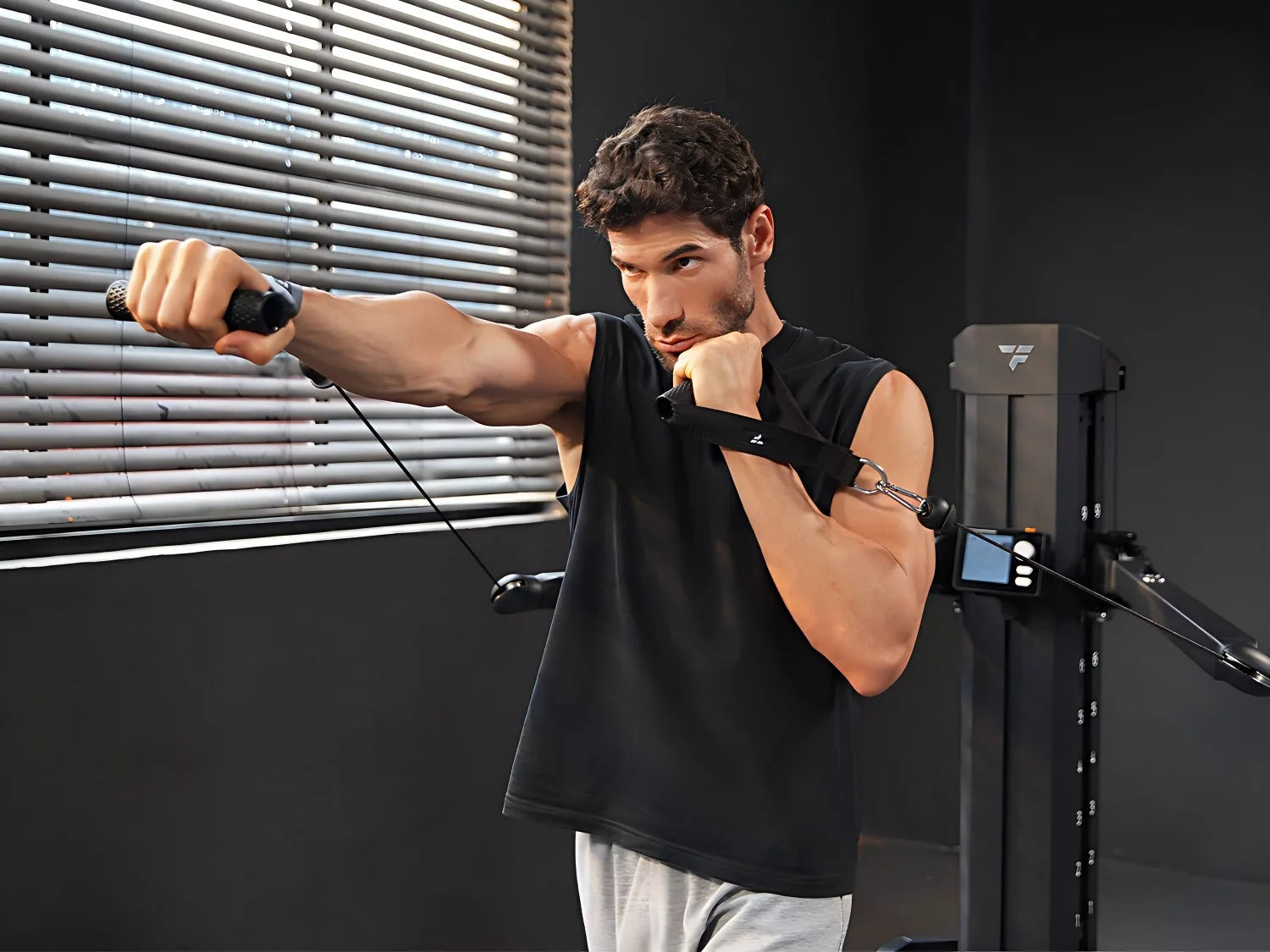
The FitTransformer Titan is a practical example of how this home gym problem gets solved. As a modular gym system, it's built around a removable core module that powers multiple training configurations, including four strength modes (Regular, Burst, Centrifuge, and Auxiliary) with a multi-directional arm adjustment system that replicates cable-style pulling from different angles. It delivers up to 264 lbs of digital resistance, requires no subscription, and folds down to about 30 inches deep when not in use.
For someone working through the cable vs free weights decision at home, this kind of design offers a concrete answer: one footprint, cable training access, and over 200 exercise variations.

How to Build a Training Plan That Uses Both Effectively
Assign each tool by what it does best: free weights for compound foundation movements, cables for precision isolation and angle-specific work.
How a Weekly Split Looks With Both Tools
|
Training day |
Free weight movement |
Cable movement |
|
Push |
Dumbbell bench press |
Cable chest fly |
|
Pull |
Dumbbell row |
High-pulley lat pulldown |
|
Legs |
Dumbbell squat or Romanian deadlift |
Cable hamstring curl |
The logic: both tools target the same muscle groups but from different mechanical angles. That combination reaches a more complete range of growth stimulus than either alone.
On the Titan, these roles map onto its four strength modes: Regular Mode for stable everyday strength work, Centrifuge Mode for slow and controlled muscle-building sets, Burst Mode for fast high-intensity training, and Auxiliary Mode for safer sessions, since it adjusts the weight automatically if you pause for more than five seconds.
When to Lean More on Cables
- Recovering from injury and needing controlled movement paths with less joint stress
- Targeting a lagging muscle (like rear delts or inner chest) that's hard to isolate with free weights
- Training at home without a spotter, where reaching failure safely requires a controlled resistance system
- Strength training after 40 and wanting to start with controlled resistance
When to Lean More on Free Weights
- Your goal is athletic performance: speed, power, coordination, and functional strength
- You're a newer lifter building foundational movement patterns
- Your primary overload method is heavy compound work with progressive loading
Stop Choosing. Start Combining.

Cable machines and free weights are not competing answers. Research shows they produce equivalent muscle growth. Training science treats them as complementary tools. Lifters who use both consistently tend to develop more fully than those committed to only one. The more useful question is how your training goals, available space, and equipment setup allow you to capture the strengths of both.
Ready to train smarter at home without giving up either cable training or movement variety? Explore FitTransformer and see what a modular gym system looks like in practice.
FAQ
Q1: Are cables better than free weights for joint pain?
For most joint issues, yes. Cables let you adjust the angle and movement path to work around discomfort while still training the muscle. Free weights load your joints against gravity in a fixed direction, which can aggravate shoulder, elbow, or lower back problems.
Cables give you more options to train around a problem rather than through it. If pain persists, have it assessed by a professional before adding load.
Q2: How do you track progressive overload on a cable machine?
Track by performance on the same machine, not by the number on the stack. Cable weight settings vary between machines, so a "50" on one machine may not equal a "50" on another. Log the weight setting, rep count, and how hard the last few reps felt. Consistent progress on those three markers is what drives muscle growth.
Q3: Can cables fully replace dumbbells?
For most isolation work, yes. Curls, lateral raises, flyes, and tricep exercises all translate well to cables. The gap shows up in pressing movements, where dumbbells allow your wrists and elbows to shift naturally throughout the rep. For floor exercises and certain grip-specific movements, dumbbells are also harder to replicate on a cable.
Q4: Are cables a good option for older adults or people returning to training?
Yes, cables are often better than free weights as a starting point for older adults. The guided resistance reduces coordination demand, and the adjustable angle helps you find a comfortable range of motion before adding load. Start light, focus on control, and build from there.
Q5: Do your gains transfer if you switch from cables to free weights?
Muscle mass transfers. Strength expression takes time. If you've trained primarily on cables and switch to free weights, expect the first two to four weeks to feel awkward and your numbers to be lower than expected. Your stabilizer muscles and coordination need time to adapt. The same adjustment happens in reverse. Plan for a short transition period when making the switch.
Q6: What is the maximum resistance on the FitTransformer Titan?
Up to 264 lbs (120 kg) of digital resistance, covering everything from heavy compound pulls to light isolation work without changing a single plate.
Q7: What strength modes does the Titan offer?
Four: Regular for stable everyday training, Burst for fast high-intensity work, Centrifuge for slow and controlled muscle building, and Auxiliary, which automatically adjusts the weight if you pause for more than five seconds, making solo training safer.