Turning 40 does not suddenly make strength training unsafe, ineffective, or fundamentally different. You can still build muscle after 40 and become stronger; the more useful shift is to match your training volume, exercise selection, and progression to your current ability and recovery instead of automatically lifting lighter because of your age.
Turning 40 does not require a separate set of strength exercises; the fundamentals of progressive resistance training still apply.
Is 40 Actually a Turning Point for Strength Training?
Forty is a useful age label for this discussion, but it is not a biological switch.
Muscle mass, strength, and physical performance can change with age, but those changes happen gradually and vary substantially between people. The National Institute on Aging notes that average declines in strength and power occur with aging, while physical activity can slow those changes and older adults can still become stronger through exercise.
Training history matters too. A 45-year-old who lifted consistently for 15 years and stopped for six months is not the same training case as a 45-year-old who has never performed resistance training. Recent activity, current health, workload, sleep, and years of training experience all affect how a program should begin.
There is also strong evidence that muscle remains trainable well beyond midlife. A 2024 systematic review of resistance training in adults age 65 and older found significant improvements in muscle size and muscle-fiber area. That does not tell us that everyone grows muscle at the same rate, but it does show that meaningful hypertrophy remains possible much later than 40.
The practical conclusion is simple: use age as context, not as the only programming variable.
Do You Need to Train Differently After 40?

Not simply because you turned 40.
The basic requirements for building muscle and strength remain familiar: train the major muscle groups, use resistance that creates an appropriate challenge, recover, and gradually make the work harder.
ACSM's 2026 resistance-training update synthesized 137 systematic reviews representing more than 30,000 participants. The guidance emphasizes consistency and individualization rather than unnecessarily complex programs, and it recognizes that bodyweight, bands, free weights, machines, and home-based training can all be effective.
Age alone does not prove that you need lighter weights or substantially longer recovery after every workout.
Adjust the program when there is an actual reason to adjust it. After a long layoff, that may mean fewer sets. If a movement repeatedly feels uncomfortable, use another variation. During a stressful month, two repeatable sessions may make more sense than trying to force three or four.
For women, perimenopause and menopause can change the broader health context around training, but they do not require an entirely different exercise library. A 2026 meta-analysis of 126 studies involving 4,019 women found significant strength improvements in both premenopausal and postmenopausal groups. Exercise selection and workload should still be individualized to current ability, symptoms, health, and goals.
What Exercises Should You Focus on After 40?
You do not need a list of special “over-40 exercises.” A practical home program should cover the major movement patterns using variations that fit your current ability and equipment.
|
Movement Pattern |
Home Exercise Options |
Practical Training Goal |
|
Squat / knee-dominant |
Chair squat, goblet squat, cable squat, step-up |
Lower-body strength |
|
Hinge |
Glute bridge, Romanian deadlift, cable pull-through |
Hip and posterior-chain strength |
|
Push |
Incline push-up, dumbbell press, cable press |
Upper-body pushing strength |
|
Pull |
Band row, dumbbell row, cable row or pulldown |
Upper-back and pulling strength |
|
Carry / core |
Suitcase carry, dead bug, Pallof press |
Bracing and loaded carrying |
|
Optional single-leg |
Supported split squat, reverse lunge, step-up |
One-side-at-a-time strength |
Choose the version you can control and tolerate. A single-leg exercise may be useful, but it is not mandatory. Mobility work also does not need to become a daily requirement; add it when a particular range of motion is limiting an exercise or when improving flexibility is one of your goals.
This is the useful meaning of functional strength training in an after-40 program: building strength that helps with things you actually want to keep doing, such as carrying groceries, climbing stairs, moving luggage, or getting up from a chair or the floor.
Cables vs Dumbbells After 40: Which Fits You Better?
Neither is universally better.
Research comparing free-weight and machine-based strength training does not show a meaningful hypertrophy advantage for one category over the other. A 2023 systematic review covering 13 studies and 1,016 adults found no significant difference in muscle growth, although strength improvements were more specific to the type of equipment used in training.
|
Factor |
Cable System |
Dumbbells |
|
Resistance adjustment |
Often quick to change |
Depends on available increments |
|
Resistance direction |
Changes with pulley position |
Mainly determined by gravity |
|
Exercise selection |
Many setups from one station |
Broad exercise selection with simple setup |
|
Storage |
One station can cover many resistance levels |
Adjustable dumbbells can be compact; fixed sets need more room |
|
Cost |
Usually higher initial investment |
Lower-cost entry options available |
|
Muscle building |
Effective with progressive training |
Effective with progressive training |
The better choice depends on the exercises you want to perform, the resistance you need, your available space, and which setup you are most likely to use consistently. Neither should be chosen simply because you are over 40.
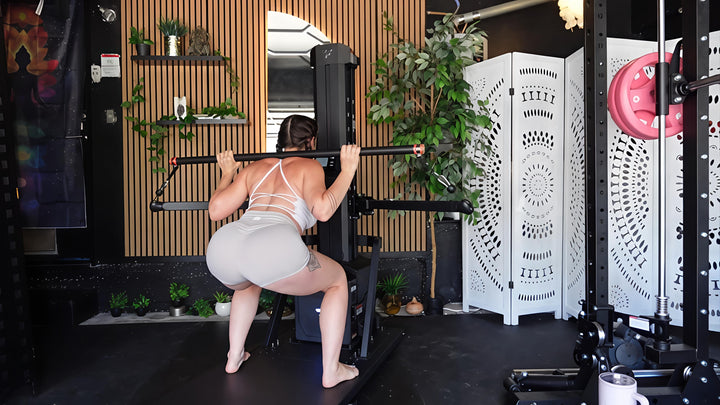
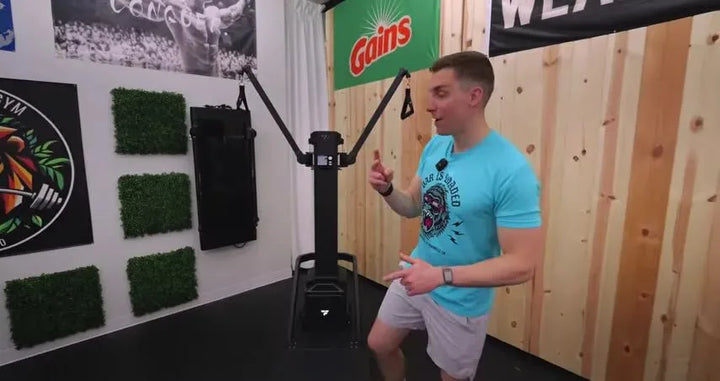
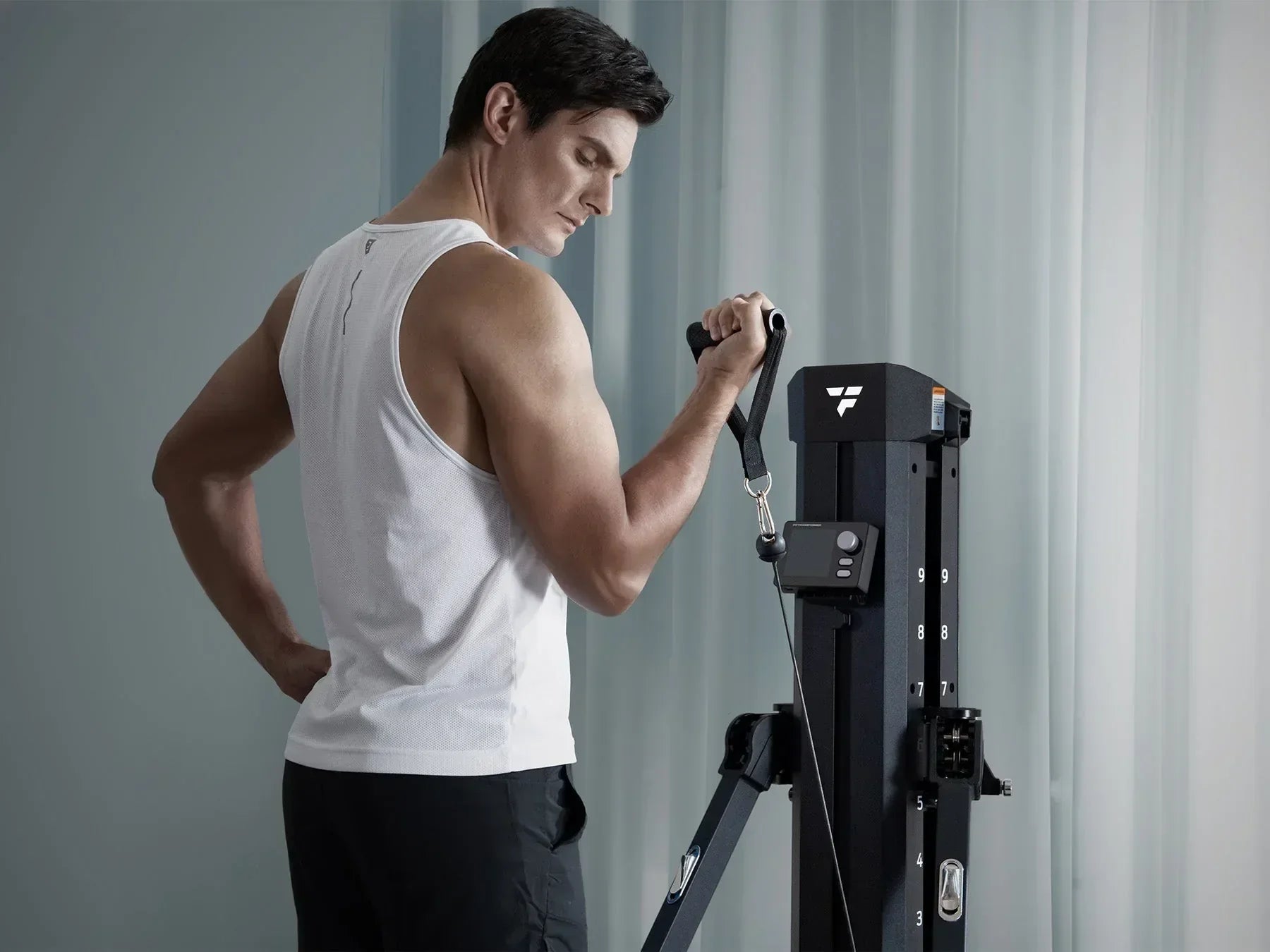
A digital cable system also does not change the biological requirements for building muscle; it mainly changes how resistance is selected and how many exercise setups can be handled from one station. The FitTransformer Titan currently lists digitally controlled resistance up to 264 lbs and more than 200 exercise variations. It may suit someone who wants a wide resistance range in one home setup, but it requires AC power and a substantially larger investment than bands or dumbbells.

An 8-Week Home Strength Plan After 40
The goal of the first eight weeks is not to make the program more complicated every week. It is to establish a small group of exercises you can repeat, measure, and gradually progress.
For many healthy adults, two full-body sessions per week are a practical starting point. ACSM's current guidance places greater emphasis on consistently training the major muscle groups than on chasing an unnecessarily complicated schedule.
Weeks 1–2: Establish the Base
Train twice per week.
Choose one exercise from each major pattern:
- Squat or knee-dominant movement
- Hinge
- Push
- Pull
- Carry or core exercise
Begin with about 1–2 working sets per exercise. A range such as 8–12 repetitions works well for many exercises, but it is not a required range for every movement.
Choose resistance that makes the set challenging while keeping the repetitions controlled. As a rough starting guide, finishing with around two or three technically sound repetitions still available can help you avoid turning every set into a maximum effort.
Rest long enough to perform the next set with similar control.
Weeks 3–4: Add Repetitions Before Adding Complexity
Keep the main exercises largely the same.
If you started near the lower end of your chosen repetition range, gradually add repetitions across subsequent sessions.
For example:
Week 1: 8, 8
Week 2: 9, 9
Week 3: 10, 10

Week 4: 11, 11 The numbers do not have to rise every workout. The purpose is to look for a trend over time.
Add another set only when the current workload is manageable and more volume serves a clear purpose. A third weekly session is optional, not a milestone you must reach.
Weeks 5–6: Use Double Progression
A simple form of progressive overload at home is double progression:
- Choose a practical repetition range.
- Keep the resistance the same while repetitions gradually improve.
- When your planned sets reach the upper end of the range with controlled technique, increase resistance slightly.
- Return toward the lower end of the range and build again.
Avoid changing several things at once. You usually do not need to add weight, add another set, shorten your rest periods, and replace the exercise in the same week.
Weeks 7–8: Keep What Is Still Working
Continue progressing the same core exercises when they still fit your goals.
At this point, review your training log:
- Are repetitions increasing at the same resistance?
- Is resistance gradually increasing?
- Are you completing most planned sessions?
- Does one exercise repeatedly cause discomfort?
- Is your current weekly workload still realistic?
Change an exercise because it solves a problem, not because eight weeks have passed.
An eight-week program does not expire when the calendar reaches Week 8.
How Do You Keep Progressing After 40?
The goal is not to avoid fatigue. It is to use a workload you can recover from and repeat consistently.
One common assumption is that recovery automatically becomes dramatically worse after 40. The evidence is more nuanced. A 2025 systematic review and meta-analysis of 36 studies did not find that advancing age was associated with greater exercise-induced muscle damage overall. That does not mean every part of recovery is identical across ages, but it does mean age alone is not enough to dictate a substantially longer recovery schedule.
Training history, total workload, exercise novelty, sleep, health, and life stress all matter.
Soreness is also not a requirement for progress. A new exercise may make you sore, while a familiar and productive session may cause very little soreness.
When Should You Temporarily Back Off?
Look for patterns across several sessions rather than reacting to one bad workout.
Consider temporarily reducing resistance, sets, or training frequency when several problems persist:
- performance continues to decline;
- normal loads repeatedly feel unusually difficult;
- soreness becomes unusually disruptive or keeps worsening;
- major life stress is making normal training difficult to repeat;
- pain changes how you perform an exercise.
Sharp, persistent, or worsening pain is different from ordinary muscular effort or mild post-training soreness. Modify or stop the provoking movement rather than treating pain as something you need to push through.
Do You Need a Deload Every 4–6 Weeks?
No.
A lighter week can be useful when fatigue accumulates or performance has been declining, but it does not need to happen on a fixed calendar.
ACSM's 2026 review also notes that complex periodization is not consistently necessary for the average healthy adult.
When the program is progressing and recovery is manageable, there is no need to interrupt it simply because a certain number of weeks has passed.
What Does Training for Longevity Actually Mean?
In this context, longevity does not mean that a particular workout guarantees a longer life.
It means maintaining muscle, strength, and the physical capacity you want to keep using as the years pass.
That gives you more useful things to track than appearance alone:
- the resistance and repetitions you can perform;
- how consistently you train;
- whether carrying groceries or luggage feels manageable;
- whether stairs feel easier;
- whether getting up from a chair or the floor remains comfortable;
- whether you can continue participating in hobbies and activities that matter to you.
For longevity, strength training is most useful when it helps preserve muscle, strength, and the physical capacity needed for everyday life.
A program does not need to look advanced to support those goals. It needs to remain challenging enough to produce adaptation and realistic enough to keep doing.
How to Keep Strength Training Working for the Next Decade
Strength training after 40 does not need to become cautious, complicated, or defined by age.
Keep training the major movement patterns. Use resistance that is appropriate for your current ability. Progress it gradually. Reduce the workload when your actual recovery or circumstances give you a reason to—not simply because of your birthday.
The long-term goal is not to finish the hardest possible eight-week program. It is to build a training routine that can keep supporting usable strength and muscle for years.
FAQs
Can You Still Build Muscle After 40?
Yes. Muscle remains responsive to resistance training well beyond age 40. Research in adults age 65 and older still shows significant increases in muscle size following resistance training.
The rate of progress varies with training experience, program design, health, nutrition, recovery, and consistency, so there is no universal muscle-gain timeline.
How Many Days a Week Should You Strength Train After 40?
Two full-body sessions per week are a practical starting point for many healthy adults. A third session can be added when it fits your goals, schedule, and recovery.
The important part is consistently training the major muscle groups rather than reaching a particular number of workout days because of your age. ACSM's 2026 guidance similarly emphasizes consistency and individualized programming.
Should You Lift Heavy Weights After 40?
You can use lighter, moderate, or heavier resistance after 40 when the load matches your exercise, training experience, and goal.
“Heavy” is relative. You do not need to test maximum lifts, and there is no benefit to adding weight when doing so causes your intended technique or range of motion to break down. Training to momentary failure is also not required for the average healthy adult.
Do You Need More Recovery After 40?
Not automatically.
Age can be part of the recovery picture, but training volume, recent training history, sleep, health, life stress, and exercise novelty also matter. Evidence comparing younger and older adults does not support the simple assumption that advancing age necessarily produces greater exercise-induced muscle damage.
Adjust recovery according to your actual performance and symptoms rather than using age alone.
Are Cable Machines Better Than Dumbbells After 40?
Not universally.
Both can support muscle and strength development when the exercises are progressively trained. Research comparing free-weight and machine training found no significant hypertrophy difference in the included studies, while strength gains tended to reflect the training method used.
Choose based on exercise preference, resistance needs, space, cost, and the setup you can use consistently.
Does Strength Training Need to Change for Women After 40 or Menopause?
The core principles do not need to be replaced. A 2026 systematic review found significant strength improvements with resistance training in both premenopausal and postmenopausal women.
Exercise selection and workload should still reflect the individual's current health, symptoms, goals, and experience. Women with diagnosed osteoporosis or a history of fragility fracture may need individualized professional guidance before following a general program.