Strength training for women at home does not require a special "toning" routine, a crowded gym, or a large equipment collection. This guide to strength and resistance training for women uses a few full-body movement patterns, an appropriate starting resistance, and small increases in difficulty that can be repeated consistently.

Women do not need a separate set of "female" exercises; the program should match the individual's goals, experience, and available equipment.
Do Women Need a Different Strength Training Program?
Beginner strength training for women does not require a separate exercise library. The basic structure of a strength program does not need to change simply because the trainee is a woman. Squatting, hinging, pushing, pulling, carrying, and controlling the trunk are useful movement categories for many adults.
What should change is the individual prescription. Exercise selection, resistance, range of motion, weekly volume, and recovery should reflect the person's experience, current ability, goals, equipment, and health status. Age, pregnancy or postpartum status, diagnosed bone conditions, persistent pain, and other medical considerations may require more specific guidance than a general beginner article can provide.
A beginner does not need to choose between very light weights and maximal lifting. Use bodyweight, bands, dumbbells, household loads, or cables at a level that feels challenging while allowing controlled repetitions.
Why Strength Training Matters for Women
Strength training can help maintain or build muscular strength, support muscle mass, provide loading that may benefit bone health, and improve the physical capacity used in daily tasks. Carrying groceries, lifting luggage, standing from the floor, and moving household objects all require some combination of lower-body, upper-body, grip, and trunk strength.
Current CDC physical activity guidance recommends muscle-strengthening activity on at least two days each week for adults, alongside aerobic activity. That recommendation is a public-health baseline rather than an individualized training prescription.
Strength also becomes increasingly relevant across adulthood. The National Institute on Aging notes that age-related losses in muscle and strength can affect physical function. Resistance training cannot stop every age-related change, but it can be part of a broader plan for maintaining physical capability.
- Muscle and strength: Regular resistance training gives muscles a reason to adapt when the challenge increases over time.
- Bone health: Appropriately selected resistance and weight-bearing activity can provide useful mechanical loading, although outcomes vary by person and program.
- Daily function: Stronger movement patterns may make routine tasks easier as training capacity improves.
- Training flexibility: Strength work can be performed at home with minimal equipment and combined with walking, cycling, or other cardio and strength training.
Before Your First Home Workout
A short setup check removes many avoidable problems before the first set:
- Clear enough floor space to squat, step, lie down, and extend your arms.
- Choose a stable chair, counter, bench, or floor surface for supported exercises.
- Prepare an easier and a harder version of each movement.
- Keep water and a simple training log nearby.
Start with easy movement and a few practice repetitions. A warm-up should help you feel prepared; it does not need one fixed duration for every person.
The 5 Movement Patterns a Beginner Program Should Cover

These five categories create a balanced foundation without requiring a long exercise list. The examples can be adjusted to match the equipment and movement options available at home.
|
Movement Pattern |
Beginner Options |
Main Training Focus |
|
Squat |
Chair squat, bodyweight squat, goblet squat |
Legs, hips, and standing control |
|
Hinge |
Glute bridge, hip-hinge drill, Romanian deadlift |
Glutes, hamstrings, and hip movement |
|
Push |
Wall push-up, incline push-up, floor press |
Chest, shoulders, and triceps |
|
Pull |
One-arm dumbbell row, band row, cable row |
Upper back, arms, and shoulder control |
|
Core control or carry |
Dead bug, side plank, suitcase carry, Pallof press |
Trunk control, bracing, and load management |
Squat
A chair squat is a useful starting point when you want a clear depth target. A goblet squat adds external resistance by holding a dumbbell or other secure load near the chest. Use the version that allows a comfortable range of motion and controlled foot and knee position.
Hinge
A glute bridge introduces hip extension from the floor. A Romanian deadlift is one way to train the hip-hinge pattern with external resistance. Keep the load close to the body and use a range that you can control without turning the movement into a lower-back exercise.
Push
Wall and incline push-ups allow difficulty to be adjusted by changing the height of the support. A floor press is another option when dumbbells are available. Choose a stable setup and a variation that lets you control the shoulders and elbows.
Pull
A one-arm dumbbell row, securely anchored band row, or cable row can train pulling strength. Pulling exercises are not a guaranteed posture correction, but they help ensure the upper back is included rather than building the entire program around pushing and lower-body work.
Core Control or Carry
Core training does not have to mean repeated crunches. Dead bugs, side planks, suitcase carries, and Pallof presses ask the trunk to resist unwanted movement while the arms or legs work.
How to Choose Your Starting Resistance
The right starting weight is not a universal number. It depends on the exercise, repetition target, equipment, and your current ability. A load that feels light for a squat may be challenging for a shoulder exercise.
The right starting resistance allows controlled repetitions while leaving a few technically sound repetitions available.
For a set of 8 to 12 repetitions, choose a resistance or exercise variation that becomes challenging near the end of the set without forcing you to rush, shorten the range unexpectedly, or lose the position you intended to maintain. Finishing with approximately two or three good repetitions still available is a practical starting cue, not a mandatory physiological threshold.
If you could complete many more repetitions with no meaningful increase in effort, the next session may need a harder variation or more resistance. If technique changes early in the set, reduce the load, use an easier variation, or lower the repetition target.
What Does "Lift Heavy" Actually Mean?
"Heavy" is relative to the person and the exercise. It does not mean testing a one-repetition maximum or choosing the largest dumbbell available. It means using enough resistance to make the planned repetition range challenging while maintaining control.
Research comparing resistance-training loads suggests that muscle growth can occur across a range of loads when sets are sufficiently challenging, while heavier loads generally have a stronger advantage for maximal-strength testing. Beginners do not need to use only very light weights, and they also do not need to train near failure to begin building a productive routine.

Your First 4 Weeks: A Beginner Strength Training Plan for Women at Home
Two full-body strength sessions per week are a practical starting point for many healthy beginners. A third session is optional when recovery, schedule, and exercise tolerance allow it. The first month should focus on learning repeatable movements rather than maximizing fatigue.
The plan below uses Workout A and Workout B. Complete one of each per week. When you add a third session, use A–B–A one week and B–A–B the next.
|
Movement |
Workout A |
Workout B |
|
Squat |
Chair squat or goblet squat |
Bodyweight squat or supported split squat |
|
Hinge |
Glute bridge |
Romanian deadlift or hip-hinge drill |
|
Push |
Incline push-up |
Dumbbell floor press or wall push-up |
|
Pull |
One-arm dumbbell row |
Band row or cable row |
|
Core |
Dead bug |
Side plank or suitcase carry |
Weeks 1–2: Learn and Repeat
- Complete Workout A once and Workout B once each week.
- Begin with 1–2 sets per exercise.
- Use approximately 6–12 controlled repetitions for most movements, while adjusting the range when the exercise requires it.
- Stop each set before technique changes noticeably.
- Keep the same core exercises long enough to compare one session with the next.
Rest until you can begin the next set without rushing. That may be less than a minute for an easy exercise or longer for a demanding lower-body movement. A fixed rest period is less important than being ready to perform the next set with control.
Weeks 3–4: Add One Measurable Challenge
- Add repetitions within the chosen range when the current resistance remains challenging.
- Add a second or third set only where recovery is manageable.
- Increase resistance in a small step when you reach the top of the repetition range.
- Use a harder variation only when the current exercise is consistently controlled.
- Change one progression variable at a time.
Do not automatically replace the program with single-leg deadlifts, unstable variations, or faster circuits in week three. Complexity is not the same as progression. A more useful goal is to perform the existing exercises with better control or a measurable increase in work.
Readers who want a longer framework after the first month can continue with this 8-week beginner strength plan.
How to Use Double Progression
Double progression provides a simple form of progressive overload for women without requiring new exercises every week.
- Choose a repetition range, such as 8–12 repetitions.
- Begin near the lower end with a resistance you can control.
- Add repetitions over later sessions until all planned sets reach the top of the range.
- Increase resistance slightly, return to the lower end of the range, and repeat the process.
This method is one form of progressive overload at home. When heavier weights are unavailable, difficulty can also increase through a more challenging variation, an additional set, a slower lowering phase, or a larger controlled range of motion.
Home strength training works when the exercises become progressively more challenging, whether resistance comes from bodyweight, bands, dumbbells, or cables.
Common Strength-Training Myths for Women
"Lifting Weights Will Make Me Bulky"
A typical beginner program is unlikely to produce sudden or accidental large increases in muscle size. Noticeable muscle gain develops gradually and depends on training volume, progression, nutrition, genetics, recovery, and time.
The word "bulky" is also subjective. A better approach is to track the outcomes you actually value, such as strength, movement confidence, exercise performance, or specific body-composition goals, and adjust training volume over time.
"Women Should Only Use Light Weights"
Light resistance can be useful when it makes the target repetition range challenging. It becomes less useful when a person can complete many repetitions without approaching meaningful effort. Women can train with light, moderate, or heavier resistance depending on the exercise and goal.

"A Good Workout Must Leave You Sore"
Soreness can occur after a new exercise or a larger workload, but it is not required for progress. Better indicators include more controlled repetitions, more work at the same resistance, a small increase in load, or improved consistency.
"Strength Training and Cardio Compete With Each Other"
Strength training and cardio support different fitness outcomes, so one does not need to replace the other. Walking, cycling, rowing, or other aerobic activity can be scheduled around strength sessions according to recovery and personal priorities.
Bodyweight, Bands, Dumbbells, or Cables: What Should You Use?
The best equipment is the option that supports your priority exercises, provides a manageable progression path, and fits the available training space.
Bodyweight
Bodyweight exercises are accessible and sufficient for starting many movement patterns. Progress may require changing leverage, range of motion, tempo, or exercise variation as strength improves.
Resistance Bands
Bands are inexpensive, compact, and useful for rows, presses, lower-body work, and assistance. Resistance changes as the band stretches, and the actual load can be difficult to compare across different bands or setups.
Dumbbells
Dumbbells support a wide range of exercises and do not require electricity. Adjustable models reduce storage needs, although fixed weight jumps may eventually make smaller progressions difficult for some movements.
Cable Systems
Cables allow the line of pull to be changed by adjusting the pulley position. That can expand exercise selection for rows, presses, lateral raises, Pallof presses, and other movements. Cables are not automatically more effective than dumbbells, and they do not reproduce every free-weight exercise. This guide to cable machines versus free weights explains the practical differences in more detail.
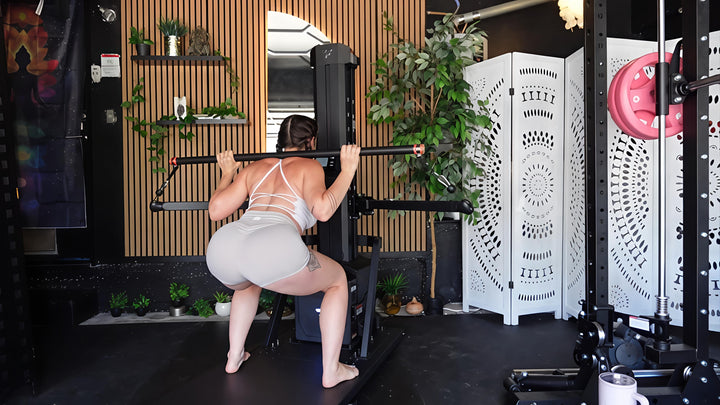
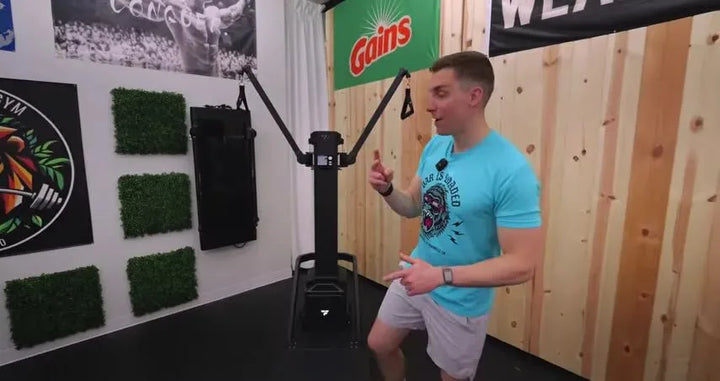
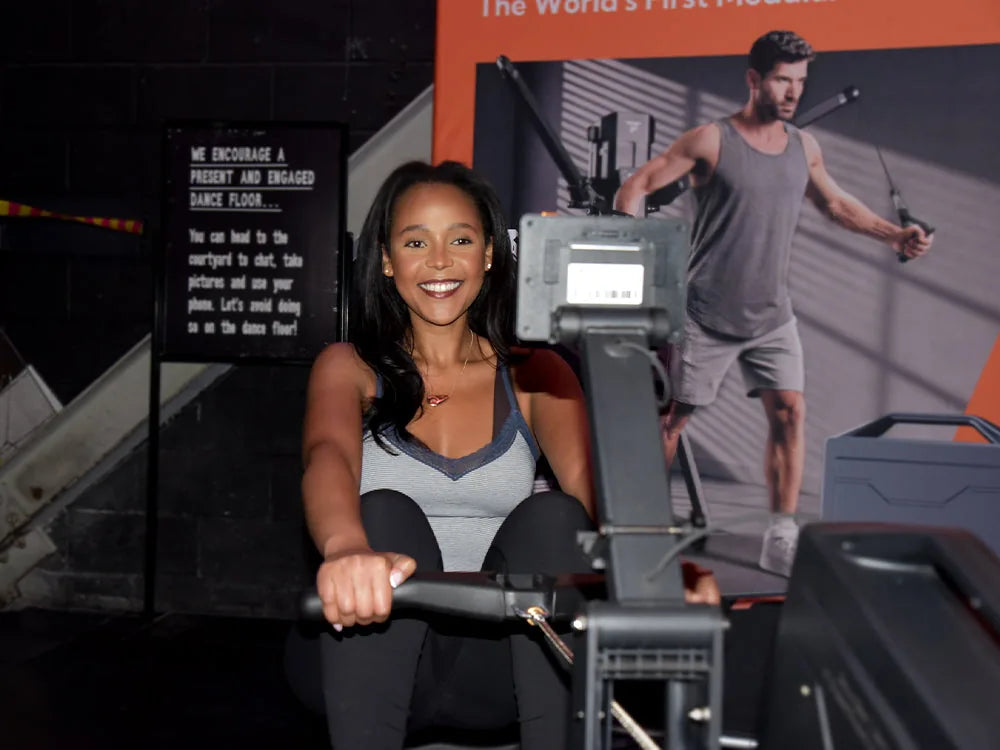
A digital cable system does not change the basic requirements for building strength. It mainly changes how resistance is adjusted, how many exercises can be set up in one place, and how much equipment needs to be stored. The FitTransformer Titan offers digitally controlled resistance, more than 200 listed movement options, and a foldable design. It also requires electrical power, enough active workout space, and a larger purchase commitment than bands or dumbbells. It is unnecessary for a beginner's first four weeks, but it may suit someone who wants a broader resistance range and multiple cable setups from one station.
What Changes After 40 or Menopause?
The basic programming principles remain the same: choose manageable exercises, train consistently, increase the challenge gradually, and adjust volume to recovery. Age alone does not determine which exercise a person can or cannot perform.
Bone-health considerations become more relevant around and after menopause because osteoporosis affects women more often than men. A systematic review of resistance training in healthy postmenopausal women supports improvements in strength, while bone-density and body-composition outcomes vary across studies and programs.
Women with diagnosed osteoporosis, a history of fractures, persistent pain, or other medical concerns need individualized guidance rather than a generic home program. Readers seeking more detail on strength training for women over 40 can use this guide to strength training after 40.
How to Measure Progress Without Relying on the Scale
Body weight and appearance may change slowly even when training is improving. A simple log provides more useful early feedback.
- Date and workout completed
- Exercise variation
- Sets and repetitions
- Resistance or household load
- Approximate effort
- Notes about control, range of motion, or discomfort
Look for trends across several sessions. Progress may appear as cleaner repetitions, more repetitions with the same load, a small resistance increase, a harder variation, better balance, or more consistent attendance. Some daily tasks may also feel easier over time, but no fixed four-week timeline applies to everyone.
One difficult workout does not mean the program has failed. Sleep, stress, illness, and normal variation can affect a single day, so evaluate trends across several weeks.
What to Do After Your First Month of Strength Training
Four weeks is not an expiration date for the plan. Continue using the same core exercises when they still match your goals and your recorded performance is improving.
Add a new exercise only when it solves a clear problem, such as a missing movement pattern, an equipment limitation, or a specific goal. Otherwise, use double progression to make the existing routine gradually harder.
Missing one session does not require restarting the month. Continue with the next planned workout. After a longer break, resume with fewer sets or lower resistance and rebuild over several sessions.
Ready for a longer plan? Continue with the eight-week beginner strength guide and use the same movement patterns to build a repeatable routine.
FAQs
Will Strength Training Make Women Bulky?
A beginner strength program is unlikely to create sudden or accidental large increases in muscle size. Muscle gain develops gradually and is influenced by training volume, progressive overload, nutrition, genetics, recovery, and time. Because "bulky" is subjective, track the outcomes you value and adjust the program when your goals change.
Do Women Need Different Strength Exercises Than Men?
No separate exercise library is required. Women and men can use the same broad movement categories, including squats, hinges, pushes, pulls, and core work. The appropriate exercise version, resistance, volume, and recovery should be individualized rather than selected by gender alone.
How Many Days a Week Should Women Strength Train?
Two full-body sessions per week are a practical starting point for many beginners and align with public-health guidance for muscle-strengthening activity. A third session can be added when recovery, schedule, and exercise tolerance allow it. More days are not automatically better when they reduce consistency or movement quality. For a deeper look at training frequency, this guide covers the key considerations.
What Weight Should a Beginner Woman Start With?
Start with a weight or exercise variation that makes the planned repetition range challenging while allowing controlled technique. For a set of 8–12 repetitions, finishing with approximately two or three technically sound repetitions available is a useful starting cue, not a rigid rule.
Can Women Build Muscle at Home Without a Gym?
Yes. Bodyweight exercises, bands, dumbbells, household loads, and cable resistance can all support muscle-building training when the exercises become progressively more challenging. The limiting factor is not the building where you train; it is whether the program provides enough resistance, consistency, recovery, and progression.
Is Strength Training Better Than Cardio for Women?
Neither needs to replace the other. Strength training primarily develops muscular strength and supports muscle and bone health, while cardio develops aerobic capacity and supports cardiovascular health. The right balance depends on the individual's goals, recovery, schedule, and preferences.