Rowing machines burn calories, yes. But the calorie number is the least interesting part. Rowing works more of your body than almost any other cardio machine, puts less stress on your joints than running, and adapts to nearly any fitness goal. Here is what actually happens when you row regularly.

8 Rowing Machine Benefits That Go Beyond the Calorie Count
1. It Works Over 80% of Your Muscles
Most cardio machines focus almost entirely on the lower body. Rowing does not. Each stroke engages the legs, back, arms, and core in sequence. A full rowing session is estimated to activate over 80 percent of the body's muscle groups, more than any other common cardio machine.
2. It Builds Cardiovascular Fitness Fast
Because so many muscles are working at once, your heart has to work harder than it does on a treadmill or bike. In one study on well-trained young rowers, adding high-intensity intervals to regular rowing training improved VO2peak by about 6.3% (from 58.4 to 62.1) in just 8 weeks.
That means their aerobic fitness and endurance capacity noticeably increased in a short time.
3. It Is Easy on Your Joints
Running puts 2.0 to 2.9 times your body weight through your knee joints with every step (Acta physiologica Scandinavica). Rowing is done seated with no ground contact at all. Your joints handle muscle tension instead of impact force. This makes rowing sustainable for people with knee or ankle issues, heavier beginners, and anyone over forty whose joints need a lower-stress option.
4. It Burns Calories and Preserves Muscle
According to Harvard Health, a 155-pound person burns approximately 252 calories in 30 minutes at moderate intensity, and 369 at vigorous effort. Because rowing works both the upper and lower body, it also preserves muscle mass during weight loss better than lower-body-only cardio like cycling or running.
5. It Strengthens Your Back and Glutes
The glutes, hamstrings, and muscles along the spine do real work during every rowing stroke. These are the same muscles that weaken from sitting at a desk all day. Rowing strengthens them as part of the cardio session, without a separate strength workout.
6. It Allows High Training Frequency
Most running programs include rest days specifically to protect the joints from cumulative impact. Rowing does not require that. What limits your rowing frequency is muscle fatigue and cardiovascular recovery, not joint wear. Four or five sessions a week is realistic for most people.
7. It Works for Both Zone 2 and High-Intensity Training
Zone 2 (a conversational pace at 60 to 70 percent of maximum heart rate) is one of the most effective formats for long-term heart health. Rowing is well-suited for it: steady, rhythmic, and easy to sustain for 20 to 50 minutes. The same machine also handles high-intensity intervals effectively, with 500-meter sprints or Tabata formats producing strong results in 15 to 25 minutes.
8. It Supports Mental Focus
The four-phase rowing stroke (catch, drive, finish, recovery) gives the mind a repeating pattern to follow. Many rowers find it easier to stay present with than open-ended treadmill running. Elite rowers have described counting strokes or focusing on a single stroke at a time as a deliberate focus practice.

Who Benefits Most from Rowing?
Rowing works for most fitness levels, but certain groups get outsized value from it.
- People with knee or ankle injuries. The seated, impact-free stroke lets you maintain cardiovascular fitness without loading the injury site.
- Heavier beginners. Running impact scales with body weight. Rowing does not. A heavier person faces the same joint load on a rower as a lighter one.
- People over 40. Lower joint wear means you can train consistently for years without accumulating the kind of damage that forces runners to take extended breaks.
- Office workers. Rowing directly targets the glutes, hamstrings, and back muscles that weaken from prolonged sitting.
- Hyrox and endurance athletes. Rowing is one of the eight Hyrox stations, and it builds the aerobic base that transfers across endurance sports.
- Anyone who wants to train 4 to 5 days a week. The low joint impact makes high-frequency training realistic in a way that running often cannot sustain.
What Muscles Does Rowing Work On?
As mentioned above, rowing activates most muscle groups in the body if done correctly.
In more detail, every stroke moves through two phases, and each phase targets different muscle groups.
Drive phase (pushing off with the legs):
- quads, hamstrings,
- glutes
- muscles along the spine
Finish phase (pulling the handle in):
- lats
- rhomboids
- biceps
- rear shoulders
The core stays engaged throughout both phases to transfer force between the lower and upper-body.

What Are the Downsides of Rowing?
Rowing has three real limitations worth knowing before you start.
- Technique takes time. Unlike walking or cycling, rowing requires learning a specific sequence of movements. Most beginners take two to four weeks to develop a stroke that feels natural and efficient.
- Lower back risk. The lower back is the most common injury site in rowers, but almost always from technique errors rather than the machine itself. Rounding the back at the catch position, pulling with the arms before the legs finish, and continuing past the point of fatigue account for most problems.
- No upper body pushing. Rowing covers pulling, hinging, and cardiovascular training. It does not cover chest press, overhead press, or any pushing movement. If upper body push strength is a goal, a separate piece of equipment is needed.
Why Does Rowing Feel Easier Than Running at First?
New rowers often notice their heart rate stays lower than expected and the workout feels manageable compared to running. The reason is not that rowing is easier. It is that beginners instinctively pull with their arms instead of driving with their legs.
The legs should generate about 65 percent of the power in a correct stroke. When that does not happen, the body is simply not working as hard as it should be. As leg drive develops over two to three weeks, the cardiovascular demand rises sharply.
Most people hit a turning point where the session that felt easy the week before becomes genuinely demanding. That shift is a sign of technical improvement.
How Many Times Should You Row?
The right frequency depends on your goal and where you are starting from.
|
Who |
Frequency |
Session Length |
Focus |
|
Beginners |
3x per week |
15 to 25 min |
Technique and base building |
|
General fitness |
3 to 4x per week |
20 to 40 min |
|
|
People over 40 |
3 to 4x per week |
25 to 40 min |
Zone 2 focus, lower intensity |
|
Athletes / Hyrox |
4 to 5x per week |
20 to 50 min |
Mix of all formats |
|
Weight loss |
4 to 5x per week |
25 to 40 min |
Higher frequency, mix of intensity |
A practical starting point for most people: three sessions per week at 20 to 25 minutes, focused on keeping form clean and effort conversational. Add a fourth session and increase duration after the first month.
How Do You Start Rowing at Home?
Step 1: Choose the right machine.
For home use, look for a machine that covers multiple resistance types.
- Air resistance performs best for hard intervals.
- Water resistance feels the most natural for steady rowing.
- Magnetic resistance is the quietest and works well for structured workouts in shared spaces.
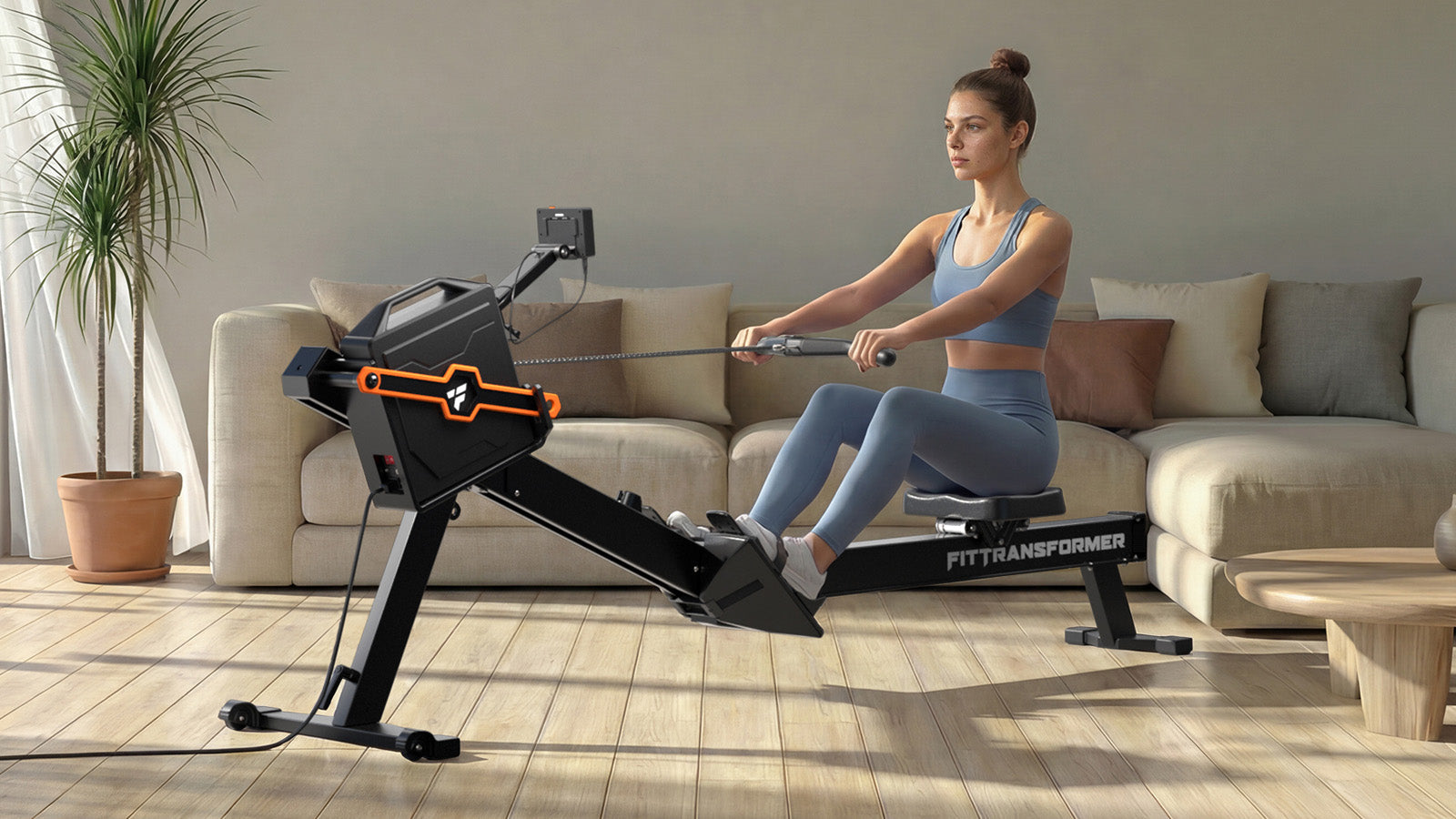
The FitTransformer Sail combines all three in one frame, so you are not limited to a single training format.

Step 2: Learn the stroke before adding intensity.
The four-phase sequence is catch, drive, finish, recovery. The legs push first, then the back leans, then the arms pull. Getting this order right protects the lower back and makes every session more effective. Spend the first two weeks rowing at low intensity with full attention on the movement sequence.
Step 3: Start with short sessions.
Fifteen to twenty minutes is enough for the first few weeks. Rowing works muscles that most people have not trained together before. Starting short lets the body adapt before you add volume.
Step 4: Build gradually.
After four weeks, add five minutes per session or a fourth weekly session. Introduce one interval session per week once the technique feels stable.
You should also build a practical plan and learn certain rowing techniques if you are a beginner.
What Is the Correct Rowing Form?
Every rowing stroke moves through four phases in sequence. Getting the order right protects your back and makes each stroke significantly more effective.
- Catch: Start with shins vertical, arms straight, back flat with a slight forward lean from the hips. This is the compressed starting position.
- Drive: Push with your legs first. This is the most important rule in rowing. Once the legs are nearly straight, lean the back slightly and then pull the arms toward the lower chest. Legs, then back, then arms. In that order, every time.
- Finish: Handle held lightly at the lower chest, elbows past the body, back leaned back slightly (not collapsed), legs fully extended.
- Recovery: Reverse the sequence. Arms extend first, body leans forward, then knees bend to slide back to the catch. Recovery should feel controlled and unhurried.
One ratio to keep in mind: the drive should be quick and powerful, the recovery slow and controlled. A 1:2 ratio (one count drive, two count recovery) is a useful starting point.
Common Mistakes to Avoid
- Pulling with your arms first. The correct order is legs, then lean back, then arms. Leading with the arms puts unnecessary stress on the lower back and limits power output. Every stroke should start with a leg push.
- Rounding the lower back at the catch. At the most compressed point of the stroke, keep the back flat. Curling forward is the single most common cause of rowing-related back pain.
- Rowing at medium effort every session. Moderate intensity every time produces weaker results than either Zone 2 (easy enough to hold a conversation) or proper intervals (hard enough to limit you to short bursts). Pick a format and commit to it.
- Skipping the technique phase. Going hard before the movement pattern is established is where most rowing injuries start. Two to three weeks of low-intensity, form-focused rowing pays off significantly over the long term.
- Continuing past fatigue. When the muscles tire, form breaks down. Most rowing injuries happen in the final minutes of a session. Stopping when form degrades is not giving up. It is training smart.
Row and Grow
Rowing covers cardiovascular fitness, full-body muscle engagement, low joint impact, and flexibility across training formats. Few single pieces of equipment do all four. The FitTransformer Sail brings air, water, and magnetic resistance into one frame, so the machine matches whatever session you have planned.
FAQs
Q1: Is rowing better than a treadmill?
For most people, yes. Rowing matches or exceeds treadmill training for cardiovascular benefit while placing far less stress on the knees and ankles. It also works the upper body, which treadmill running does not. The main advantage of a treadmill is a lower learning curve. Correct rowing technique takes a few weeks to develop.
Q2: Is a rowing machine good for weight loss?
Yes. Rowing burns more calories per session than most low-impact options, and the full-body muscle engagement helps preserve lean mass during a calorie deficit. Muscle preservation matters because it keeps the metabolism from slowing down during weight loss.
Q3: How long does it take to see results from rowing?
Four to six weeks for cardiovascular changes. Resting heart rate drops and recovery improves first. Visible muscle changes take eight to twelve weeks. Performance improvements (faster times, lower heart rate at the same effort) are typically measurable within six to eight weeks of consistent training.