Functional strength training builds strength around how your body actually moves, not around isolated muscles on a fixed machine. It trains pushing, pulling, squatting, hinging, rotating, and carrying in patterns that directly improve daily performance, athletic ability, and resilience.
What Is Functional Strength Training?
In simple terms, functional training bridges the gap between the gym and real life. It focuses on how your body moves as a whole, rather than how a single muscle looks.
| Feature | Isolation Training | Functional Training |
|---|---|---|
| Focus | Single muscles (e.g., Biceps) | Movement patterns (e.g., Pulling) |
| Equipment | Fixed machines | Free weights, cables, bodyweight |
| Primary Goal | Muscle size / Aesthetics | Real-world performance / Stability |
| Result | Strong "on the rack" | Strong "on the field" |
Movements Over Muscles
Traditional gym machines isolate one muscle at a time. Functional training focuses on movement patterns:
- The Big Six: Push, Pull, Squat, Hinge (bending), Rotate, and Carry.
- The Difference: Instead of being locked into a fixed track on a machine, you use free weights or cables. This forces your prime movers, opposing muscles, and stabilizers to work together simultaneously.
Strength That Transfers
This is "useful" strength. The gains you make in the gym show up in your daily life and sports:
- Life: Carrying heavy groceries, hiking, or moving furniture.
- Sport: Boosting performance in basketball, swimming, or HYROX race.
- The Logic: Isolation training makes you stronger at using a specific machine. Functional training makes you stronger at everything else.
The Big Misconception
Functional does NOT mean "light weights."
Many people think functional training is just balancing on balls with tiny dumbbells. That's a myth. Heavy squats, deadlifts, and farmer's walks are the gold standard of functional movement. The goal is movement quality and carry-over, not just lifting light.
Why Functional Training Transfers Better?
It's all about three physiological "secrets" that make gym strength usable in the real world:
1. Smarter Brain-to-Muscle Connection
Strength is a skill. On a fixed machine, your brain is "lazy" because the machine guides you. In functional training (free weights/cables), your brain must constantly adjust the path and speed. This neuromuscular coordination mimics how you actually move in life.
2. Waking Up the "Stabilizers"
Machines do the balancing for you; functional training makes you do the work.
- It activates deep muscles in your core, hips, and shoulders that machines ignore.
- These stabilizers are what keep you from getting injured when you trip or lift a heavy box.
3. Moving in 3D (Multi-Plane Force)
Life doesn't happen on a straight track.
- Most gym machines only move forward and backward (Sagittal plane).
- Functional training adds side-to-side and rotational movements (like lateral lunges or woodchops). This prepares your body for the twists and turns of real-world activity.
What This Means for Non-Athletes
For the average person, this means more "bang for your buck." You'll notice the difference when carrying groceries, climbing stairs, or simply sitting at a desk without back pain. It's about building a body that works as well as it looks.
The 6 Essential Movements for a Functional Body
A complete functional strength workout covers six foundational patterns. If any are missing from your routine, that gap is where injuries and plateaus tend to appear.
1. Hip Hinge
Deadlift, kettlebell swing, Romanian deadlift. Cable version: low cable pull-through, cable good morning. Trains safe lifting from the ground and full posterior chain strength.
-
Real-world carryover: This is how you pick up a heavy suitcase or a toddler from the floor without straining your lower back. It teaches you to use your hips instead of your spine for heavy lifting.

2. Squat
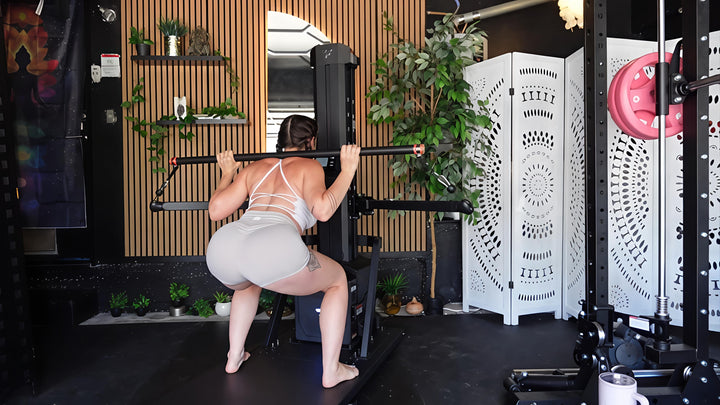
Back squat, Bulgarian split squat, goblet squat. Cable version: cable squat, cable split squat. Directly trains the ability to stand up, climb stairs, and get off the floor.
-
Real-world carryover: Essential for getting in and out of a low car or rising from a deep sofa with ease and balance.

3. Horizontal Push
Push-up, dumbbell bench press. Cable version: cable chest press, single-arm cable press (adds anti-rotation demand). Builds the upper-body pushing chain.
-
Real-world carryover: Directly translates to shoving open a heavy commercial door or pushing a piece of furniture across the room.

4. Horizontal Pull
Barbell row, inverted row. Cable version: seated cable row, single-arm cable row. Strengthens the back and directly counters rounded posture from desk work.
-
Real-world carryover: Helps with pulling a stubborn lawnmower starter cord or opening a heavy gate, while keeping your shoulders healthy and upright during long office hours.

5. Vertical Pull
Pull-up, lat pulldown. Cable version: cable pulldown, straight-arm pulldown. Develops climbing strength and shoulder stability.
-
Real-world carryover: Useful for pulling down a heavy box from a high garage shelf or pulling yourself up if you ever need to climb a ladder or a fence.

6. Rotation and Anti-Rotation
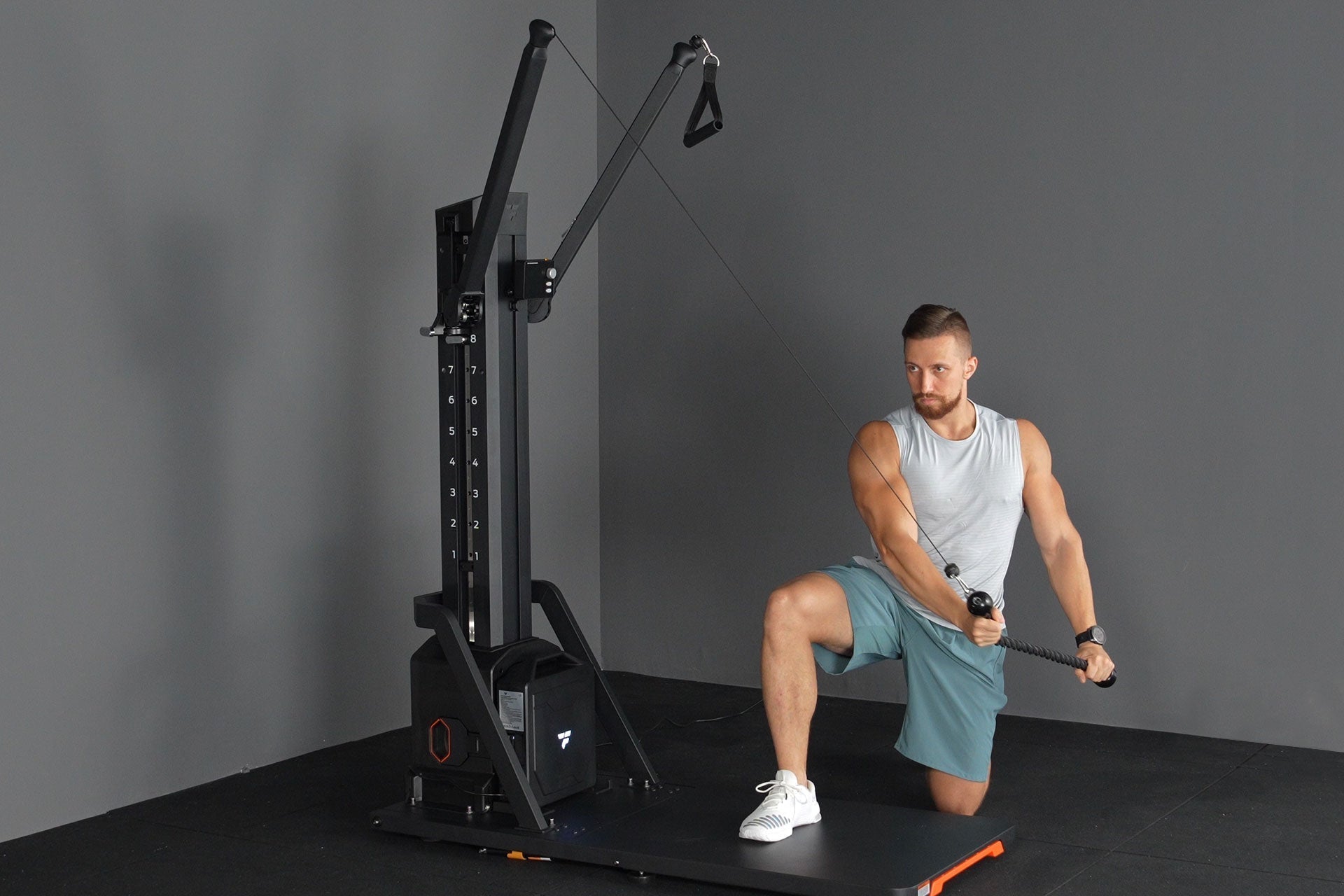
Cable woodchop, Pallof press, landmine rotation. Core stability under rotational force. Rotation is the pattern most commonly missing from traditional programs and the most critical for injury prevention. Fixed machines cannot train it effectively. Cable systems handle it best.
-
Real-world carryover: This is the strength you use when reaching for a seatbelt, swinging a golf club, or staying balanced when someone bumps into you in a crowded space.

Spot Your Training Blind Spots
Check your current program against all six. The most common gaps are rotation/anti-rotation and horizontal pulling. A cable system covers all six patterns, and rotation work is where cable resistance offers the clearest advantage over other home setups.
A Functional Strength Training Plan for Home Use
Below is a three-day full-body plan built on the six movement patterns. All cable exercises can be performed on a single cable station.
Day A: Push + Hip Hinge + Anti-Rotation
| Exercise | Pattern | Sets x Reps |
|---|---|---|
| Single-arm cable chest press | Horizontal push | 3 x 10/side |
| Romanian deadlift (cable, low position) | Hip hinge | 3 x 8 |
| Pallof press | Anti-rotation | 3 x 12/side |
| Cable reverse fly | Push accessory | 2 x 15 |
Day B: Pull + Squat + Rotation
| Exercise | Pattern | Sets x Reps |
|---|---|---|
| Single-arm cable row | Horizontal pull | 3 x 10/side |
| Cable split squat | Squat | 3 x 8/side |
| Cable woodchop (high to low) | Rotation | 3 x 10/side |
| Cable lat pulldown | Vertical pull | 3 x 10 |
Day C: Full-Body Integration
| Exercise | Pattern | Sets x Reps |
|---|---|---|
| Cable deadlift | Hip hinge | 3 x 8 |
| Straight-arm pulldown | Vertical pull | 3 x 10 |
| Farmer's walk | Loaded carry | 3 x 20 meters (about 65 feet) |
| Cable reverse woodchop (low to high) | Rotation | 3 x 10/side |
Every cable movement above fits on a single adjustable cable station. No wall of separate fixed machines required.
How to Progress
In functional training, progress is not always about adding weight. Improving movement quality, slowing the eccentric phase, and shortening rest periods all count.
Every four weeks, assess: can you complete the full rep range with clean technique? If yes, add a small increment. If form breaks down, hold the weight and refine control.
Fit for Life
Functional strength training is not a replacement for all traditional lifting. It is a different emphasis with a different outcome.
If the goal is strength that transfers to how you actually move outside the gym, organizing training around movement patterns rather than isolated muscles gets you there faster.
The six patterns above cover what the human body needs to move well. Train all six consistently, and the results compound.
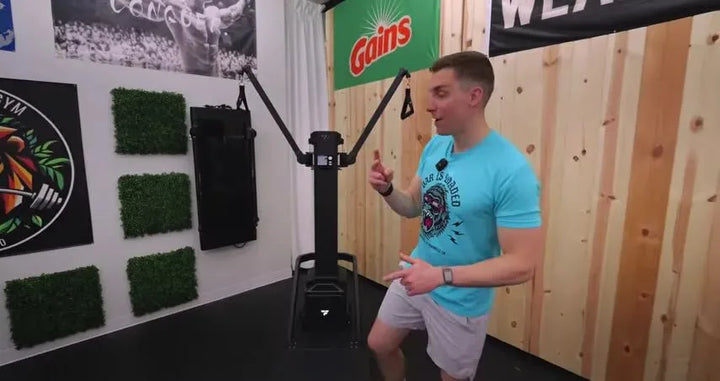
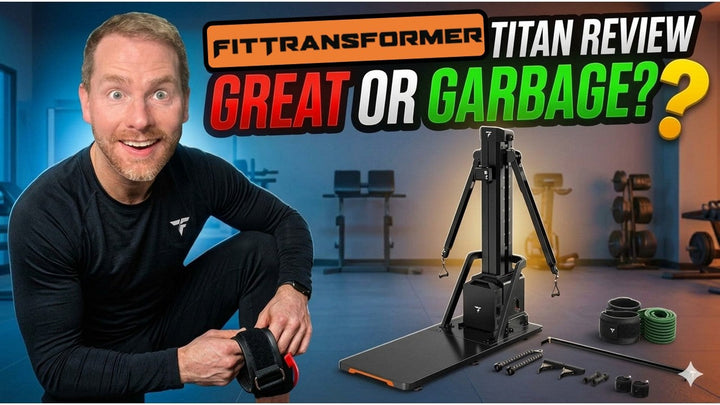
The FitTransformer Titan handles every pattern in this plan with up to 264 lbs of digitally controlled resistance, adjustable arm positions, and a compact footprint. One station, all six patterns, no gaps.

FAQs
Q1: Is functional strength training good for building muscle?
Yes. Multi-joint functional exercises produce substantial muscle growth, especially in the posterior chain and core.
For maximizing the size of a single muscle, isolation work is more targeted. For overall strength plus muscle development, functional training delivers a more complete result.
Q2: How is functional training different from CrossFit?
CrossFit is one specific methodology that uses functional movements alongside high-intensity conditioning and competitive elements. Functional strength training is a broader principle. It can be done at any intensity, with no competitive format and no emphasis on speed of completion.
Q3: Can functional strength training help with back pain?
Yes. Targeted functional training improves chronic, non-specific lower back pain by strengthening spinal stabilizers and hip muscles.
Pallof presses and Romanian deadlifts are two of the most valuable exercises for this purpose. During an acute flare-up, rest first. For chronic issues, start with very low loads.
Q4: How often should I do functional strength training per week?
Two to three full-body sessions per week works for most people. Place functional strength days between cardio sessions so your neuromuscular system can recover.
Fewer than two sessions slows adaptation. More than four without structured programming reduces movement quality.