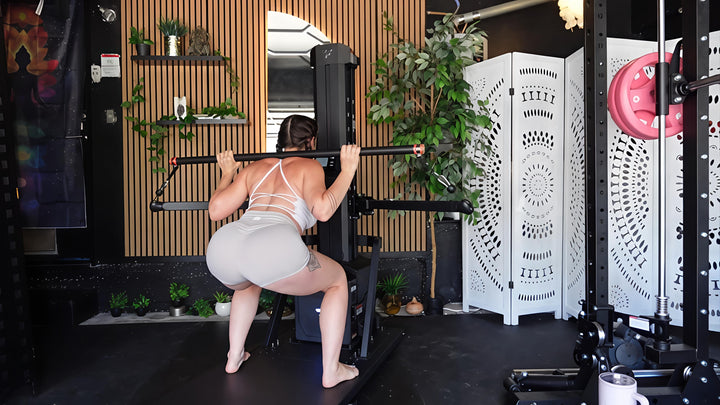
One bench can train your chest, shoulders, back, and arms from seven different angles. These 10 adjustable bench exercises cover every major upper body muscle, with exact angle settings, sets, and reps for each movement. Run them with dumbbells or with FitTransformer Titan cable resistance; either way, Spine Lock support keeps each press locked in.
The 10 Exercises at a Glance
|
# |
Exercise |
Bench angle |
Primary muscles |
Equipment |
|
1 |
Flat Bench Press |
0° |
Chest, triceps, front delts |
Dumbbells, barbell, or Titan |
|
2 |
Incline Bench Press |
30° |
Upper chest |
Dumbbells or Titan |
|
3 |
Alternating Bench Press |
0° |
Chest, core anti-rotation |
Dumbbells or Titan |
|
4 |
Bench Chest Fly |
0° |
Chest isolation |
Dumbbells or Titan |
|
5 |
Incline Bench Reverse Fly |
30°-45° |
Rear delts, rhomboids |
Dumbbells |
|
6 |
Seated Overhead Press |
84° |
Delts, triceps |
Dumbbells or Titan |
|
7 |
Seated Lat Pulldown |
84° |
Lats |
Titan required |
|
8 |
Seated Row |
84° |
Mid back, lats, biceps |
Titan required |
|
9 |
Contralateral Supported Row |
0° (bench as support) |
Lats, mid back |
Dumbbell |
|
10 |
Seated Bicep Curl |
84° |
Biceps |
Dumbbells or Titan |
What Muscles Can You Train on an Adjustable Bench?
Chest (upper, middle, and lower fibers), all three deltoid heads, triceps, biceps, and the lats and mid back through pulldowns and supported rows. The backrest angle decides which muscle leads.
EMG research comparing five bench inclinations found a clear pattern: the flat position produces the highest activity in the middle and lower chest, a 30° incline produces the highest activity in the upper chest, and angles above 45° shift the work toward the front delts.
|
Backrest angle |
Main target |
|
0° |
Middle and lower chest, triceps |
|
15°-30° |
Upper chest |
|
45° |
Upper chest and front delts |
|
60° |
Front and side delts |
|
72°-84° |
Shoulders, upright support for back and arm work |
The FitTransformer Adjustable Bench hits every row of that table with its 0°, 15°, 30°, 45°, 60°, 72°, and 84° settings.
What Are the 10 Best Adjustable Bench Exercises?
Each movement below appears in the FitTransformer Training Library with a full video demo. Exercises 7 and 8 need the FitTransformer Titan for cable resistance; everything else runs on dumbbells, with Titan grips as an option. Rest 60 to 90 seconds between sets unless noted.
1. Flat Bench Press (0°)
The foundation of upper body strength. Lie flat with your feet planted, press up, and control the return without bouncing at the bottom. 3-4 sets of 6-10 reps.
Spine Lock tip: insert the 3 cm side of the scapular module. It fills the gap under your upper back, so your shoulder blades stay retracted through every rep.

2. Incline Bench Press (30°)
The top upper-chest builder, backed by the activation research above. Press upward and slightly inward, avoiding shrugged shoulders and flared elbows. 3-4 sets of 8-12 reps.
Spine Lock tip: flip the module to the 6 cm side, built for incline pressing in this range.

3. Alternating Bench Press (0°)
Hold both weights at chest level, press one arm while the other stays loaded and still, then switch. The static side teaches shoulder stability while your core resists tilting. 3 sets of 8-10 reps per side.

4. Bench Chest Fly (0°)
A stretch-focused chest isolator. Soft elbows, wide arc, squeeze at the top. Avoid locking your elbows or overstretching your shoulders at the bottom. 3 sets of 10-15 reps.

5. Incline Bench Reverse Fly (30°-45°)
Lie chest-down on the inclined pad with arms hanging, then lift the weights outward and retract your shoulder blades. The pad support removes momentum, so the rear delts and rhomboids do every rep. 3 sets of 12-15 reps.

6. Seated Overhead Press (84°)
Set the backrest to its steepest 84° position, sit tall, and press until your arms extend. The near-vertical pad takes load off your lower back. Avoid arching or banging the weights together overhead. 3-4 sets of 8-12 reps. The Training Library also includes a seated barbell version of this press.

7. Seated Lat Pulldown (84°) | Titan required
Sit tall against the upright pad, grip the cables high, and pull to your upper chest while leading with your elbows. Avoid leaning back to cheat the weight down. 3 sets of 10-12 reps. The library includes wide-grip and single-arm variations.

8. Seated Row (84°) | Titan required
Sit tall, pull the grips toward your ribs, and squeeze your shoulder blades together. The neutral-grip version targets mid-back thickness; the wide-grip version shifts work to the rear delts and upper back. 3 sets of 10-12 reps.

9. Contralateral Supported Row (0°)
Place one hand and knee on the flat bench, keep your back flat, and row the dumbbell to your hip. The support kills lower-back strain and body English. 3 sets of 10-12 reps per side.

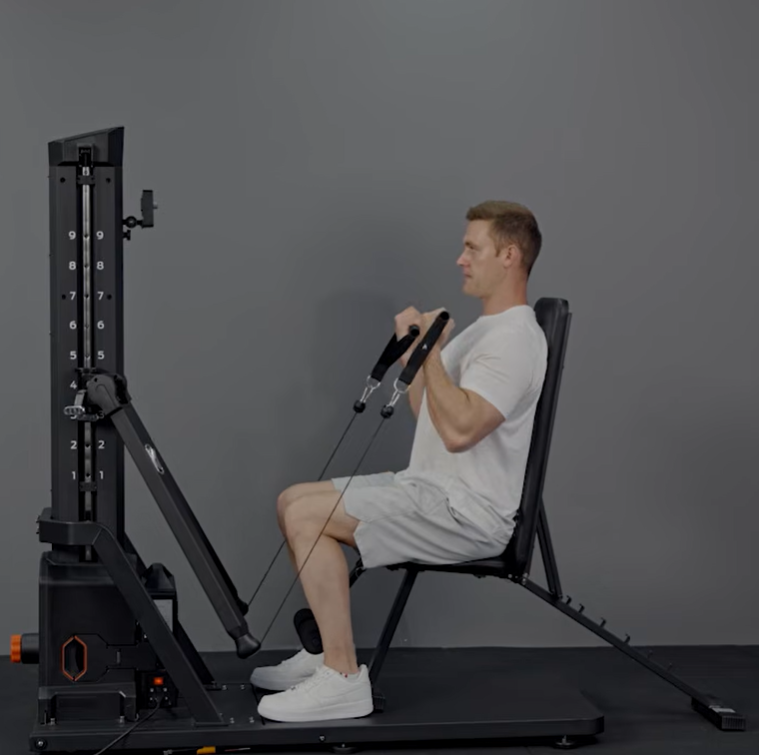
10. Seated Bicep Curl (84°)
Sit tall against the upright backrest with elbows pinned at your sides, curl up, and control the descent. The pad removes the torso swing that robs standing curls of tension. 3 sets of 10-12 reps. With the Titan, the single-arm preacher curl makes a strict alternative.

What's the Best Angle for Incline Press?
30° for upper chest growth. A five-angle EMG study recorded the highest upper-pec activity at a 30° inclination, while angles above 45° produced clearly higher front-delt activity and reduced chest output.
The official Training Library demo for the incline bench press sets the pad in the same 30°-45° window, matching what the research supports.
A practical way to use the FitTransformer settings:
- 15°: a low incline that keeps the whole chest involved, useful for lifters transitioning from flat work
- 30°: the prime upper-chest setting for incline pressing
- 45°: a chest-and-delt blend, and the upper end of the recommended pressing range
Incline Bench Press Tips for Beginners
- Start at 15° or 30°, not steeper.
- Pick a weight you can press for 10 controlled reps.
- Lower the weights to upper-chest level, not your neck.
- Drive your feet into the floor on every rep.
The Spine Lock module makes the setup easier to repeat. With the 6 cm side under your upper back, your shoulder blades lock into a retracted position and your chest opens naturally, the exact setup coaches cue on every incline press.
How Do You Bench Press with Proper Form?
Grip slightly wider than shoulder width, pull your shoulder blades back and down, set a natural arch, and lower the weight to your mid chest under control.
Step by Step
- Set your grip. Hands slightly wider than shoulders, wrists stacked over forearms.
- Retract your scapulae. Pull your shoulder blades back and down into the pad.
- Set the arch. A modest, natural arch in your upper back, hips staying on the bench.
- Control the path. Lower to your mid chest, press back up and slightly toward your face.
On a flat pad, step 2 and step 3 demand constant tension to maintain. The Spine Lock module changes that: the raised block sits under your upper back, giving your scapulae a fixed anchor. In FitTransformer's athlete testing, lifters rated the Spine Lock setup higher for stability during movement and comfort under load compared with a traditional flat pad.
Pressing with the FitTransformer Titan adds another layer of safety: cable resistance has no bar to get pinned under, so heavy pressing at home carries less risk than a barbell without a spotter.
Can You Do a Full-Body Workout with It?
Yes. The angles plus dumbbells or Titan cables cover pushing, pulling, arms, shoulders, legs, and core in a single circuit, and every movement below has a Training Library video. For a structured upper body workout plan that pairs with this bench, the FitTransformer blog covers full programming options.
Sample Full-Body Circuit
Run the list as a circuit, 3 rounds, resting 90 seconds between rounds.
|
Order |
Exercise |
Angle |
Reps |
|
1 |
Flat Bench Press |
0° |
10 |
|
2 |
Contralateral Supported Row |
0° |
12 per side |
|
3 |
Bulgarian Split Squat (rear foot on bench) |
0° |
10 per leg |
|
4 |
Seated Overhead Press |
84° |
10 |
|
5 |
Prone Knee Drive (hands on bench) |
0° |
10 per side |
|
6 |
Seated Bicep Curl |
84° |
12 |
No squat rack required: every movement runs on dumbbells, bodyweight, and the bench itself, which makes this a complete home gym upper body workout with leg and core work built in.

Want the cable-based half of the list? The Titan Plus pairing adds the FitTransformer Titan, a foldable cable machine with up to 264 lbs of resistance, unlocking the seated pulldowns, rows, and cable presses on this list.
What's the Best Beginner Workout Routine?
Three sessions per week, full upper body each time, resting at least one day between sessions.
3-Day Adjustable Bench Workout Routine
Day 1: Press Focus
|
Exercise |
Angle |
Sets x Reps |
Rest |
|
Flat Bench Press |
0° |
3 x 10 |
90 sec |
|
Incline Bench Press |
30° |
3 x 10 |
90 sec |
|
Contralateral Supported Row |
0° |
3 x 12 per side |
60 sec |
|
Seated Bicep Curl |
84° |
2 x 12 |
60 sec |
Day 2: Shoulders and Back
|
Exercise |
Angle |
Sets x Reps |
Rest |
|
Seated Overhead Press |
84° |
3 x 10 |
90 sec |
|
Incline Bench Reverse Fly |
30° |
3 x 12 |
60 sec |
|
Seated Lat Pulldown (Titan) or Contralateral Row |
84° / 0° |
3 x 10 |
90 sec |
|
Bench Chest Fly |
0° |
3 x 12 |
60 sec |
Day 3: Mixed Volume
|
Exercise |
Angle |
Sets x Reps |
Rest |
|
Incline Bench Press |
30° |
3 x 12 |
90 sec |
|
Bench Chest Fly |
0° |
3 x 15 |
60 sec |
|
Alternating Bench Press |
0° |
2 x 8 per side |
90 sec |
|
Seated Overhead Press |
84° |
2 x 12 |
90 sec |
How to Progress
Start weeks 1-2 with the supported, stable movements: contralateral rows, reverse flies, seated curls. They teach scapular control with low risk. From week 3, build the heavier compound presses into the first slot of each day and add a small amount of weight any week you complete every listed rep. A structured guide to strength training for beginners covers how to pace that progression week by week.
FAQs
Q: How often should I train with an adjustable bench?
Two to four sessions per week works for most lifters. Give each muscle group at least 48 hours of recovery between hard sessions.
Q: Is an adjustable bench enough for a complete home gym?
Paired with dumbbells, an adjustable bench covers presses, flies, rows, curls, shoulder work, and bench-supported leg movements. Adding the FitTransformer Titan brings cable resistance up to 264 lbs for the seated pulldowns and rows on this list.
Q: What's the difference between flat, incline, and decline bench exercises?
Flat pressing loads the middle and lower chest hardest, incline angles around 30° shift emphasis to the upper chest, and decline biases the lower chest. EMG research on bench angles shows flat pressing already drives strong lower-chest activity, so a flat-to-84° bench covers complete chest development.
Q: Do I need a spotter when using an adjustable bench with a power rack?
For heavy barbell pressing, a spotter or rack safety catches remain the safest option. Dumbbell pressing carries less risk because the weights can be dropped to the sides, and cable pressing on the Titan removes the pinning risk entirely.
Q: How does the Spine Lock feature help with bench press form?
The raised module anchors your shoulder blades in a retracted position and supports a natural arch, the two hardest parts of a pressing setup to hold. Use the 3 cm side for flat work and the 6 cm side for incline pressing.
Fit 10+ Moves Into One Bench
These 10 exercises are a starting lineup, not the limit: seven angles, dumbbells, and Titan cables open up dozens of variations on the FitTransformer Adjustable Bench, and every movement on this list has a video demo waiting in the Training Library. Start with the 3-day beginner routine, progress to the heavier compounds, and add the Titan when you want cable resistance. See the bench at the FitTransformer official store.